
PFAS-Free Fabrics with Controlled Production and Testing
CC Textile produces PFAS-free fabrics through a documented production system that begins with yarn sourcing and continues through weaving, dyeing, finishing and final fabric verification.
Our approach combines no intentionally added PFAS, dedicated production equipment, controlled water sources, chemical documentation and three-stage independent laboratory testing.
We do not make an undefined claim of “absolute zero PFAS.” Instead, we explain exactly what has been controlled, what has been tested and what each laboratory result means.
[DISCUSS YOUR PFAS REQUIREMENT]
Link: https://cc-textile.com/contact/
[VIEW OUR FABRICS]
Link: https://cc-textile.com/products/
What “PFAS-Free” Means at CC Textile
PFAS refers to a broad class of fluorinated substances. A targeted laboratory test evaluates a defined list of substances using a specified analytical method and reporting limit. It cannot establish the absolute absence of every possible PFAS compound.
At CC Textile, PFAS-free fabric means:
- PFAS are not intentionally added to the yarns, dyes, auxiliaries, softeners, DWR agents or other finishing chemicals used for the project.
- The production route uses dedicated equipment that is not shared with fluorinated products.
- Contamination risks are controlled from yarn sourcing through final finishing.
- Independent testing is performed at three production checkpoints.
- Test results are evaluated against the substance list, method and limits agreed for the customer’s destination market and product requirements.
“PFAS-free” is therefore used as a practical commercial description of this controlled approach. It is not presented as an unverifiable claim of absolute chemical zero.
Why We Use a Dedicated Fluorine-Free Production Route
Producing PFAS-free fabrics requires more than changing the final DWR chemistry. Cross-contamination must be controlled throughout the production route.
At very low reporting limits, trace carryover from previous fluorinated production can affect a test result.
Once fluorinated chemistry has been processed on textile machinery, cleaning alone may not provide sufficient assurance that every residual source of cross-contamination has been removed. For this reason, CC Textile does not alternate between fluorinated and non-fluorinated products on the equipment assigned to its PFAS-controlled production route.
The equipment used for weaving, dyeing and finishing these fabrics does not process fluorinated products.
This dedicated route gives apparel brands a more controlled foundation than relying only on a final finished-fabric test.
How CC Textile Produces PFAS-Free Fabrics
Yarn and Raw-Material Documentation
PFAS control begins before weaving.
Yarn suppliers are required to provide a No Intentionally Added PFAS declaration or equivalent supporting documentation. This establishes the initial chemical requirement before the yarn enters production.
Suppliers of dyes, auxiliaries, softeners, water-repellent agents and other finishing chemicals are also required to provide relevant declarations or technical documentation confirming that PFAS are not intentionally added.
When water repellency is required, a documented fluorine-free C0 DWR route is selected according to the fabric application and agreed performance target.
Controlled Weaving
Air-jet weaving is normally used for PFAS-controlled woven fabric production.
When a construction requires water-jet weaving, recirculated process water is not used. Fresh steam condensate supplied by the thermal power plant is used to reduce contamination risks associated with recycled water.
The greige fabric is independently tested before it proceeds to dyeing.
Controlled Dyeing
Dyeing is carried out through an approved partner using equipment dedicated to the fluorine-free production route.
Steam condensate is used as the controlled water source, and the dyes and auxiliaries must meet the project’s chemical documentation requirements.
After dyeing and before final finishing, the fabric is submitted for the second independent PFAS test.
Dedicated Finishing
Finishing is performed on dedicated equipment that does not process fluorinated products.
All finishing agents must meet the agreed no-intentionally-added-PFAS documentation requirements. This includes softeners, water-repellent agents and other functional treatments used for the specific fabric.
Following finishing, the completed fabric is submitted for the third and final third-party PFAS test.
Three Independent Testing Checkpoints for Every Order
Each order for PFAS-free fabrics is independently tested at three stages:
- Greige Fabric Before Dyeing
Confirms the condition of the woven fabric before dyes and processing auxiliaries are introduced. - Dyed Fabric Before Finishing
Checks the fabric after the dyeing process and before final functional treatments. - Final Finished Fabric
Verifies the material after all specified finishing processes have been completed.
The testing scope is not automatically identical for every project. The target substances, analytical method and reporting limits are selected according to the customer’s destination market, product application, brand requirements and agreed testing protocol.
Customers may nominate their preferred testing laboratory. Where no laboratory is specified, CC Textile and the customer can select an appropriate independent provider, such as Intertek, SGS, Bureau Veritas or TÜV SÜD.
These organizations are referenced as possible independent testing providers and not as certifiers of CC Textile’s entire production operation.
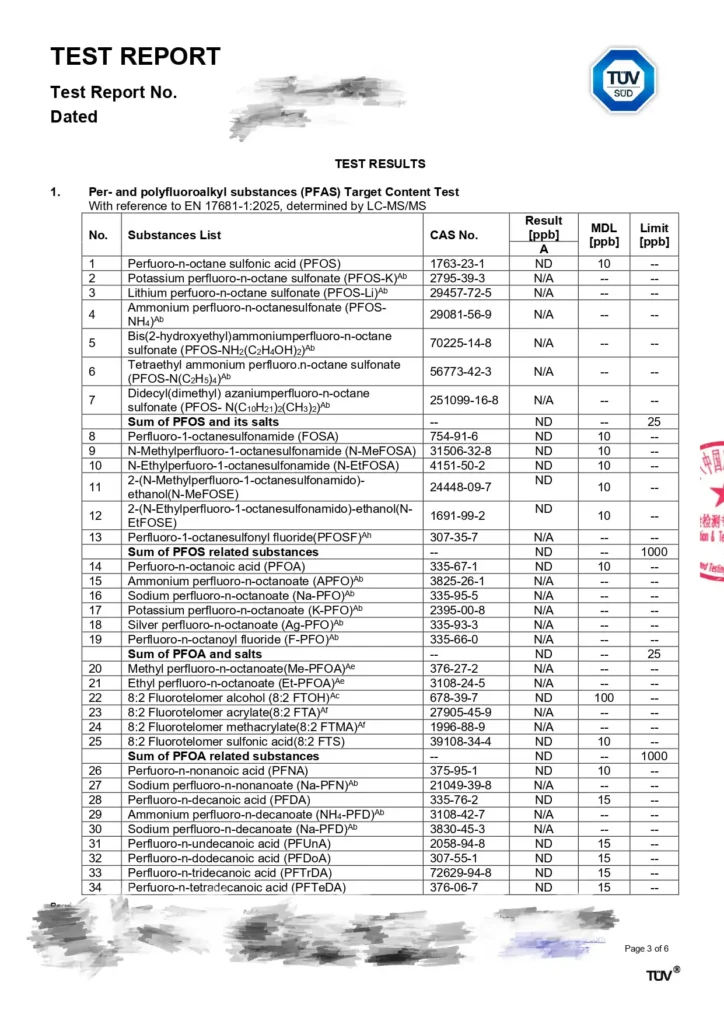
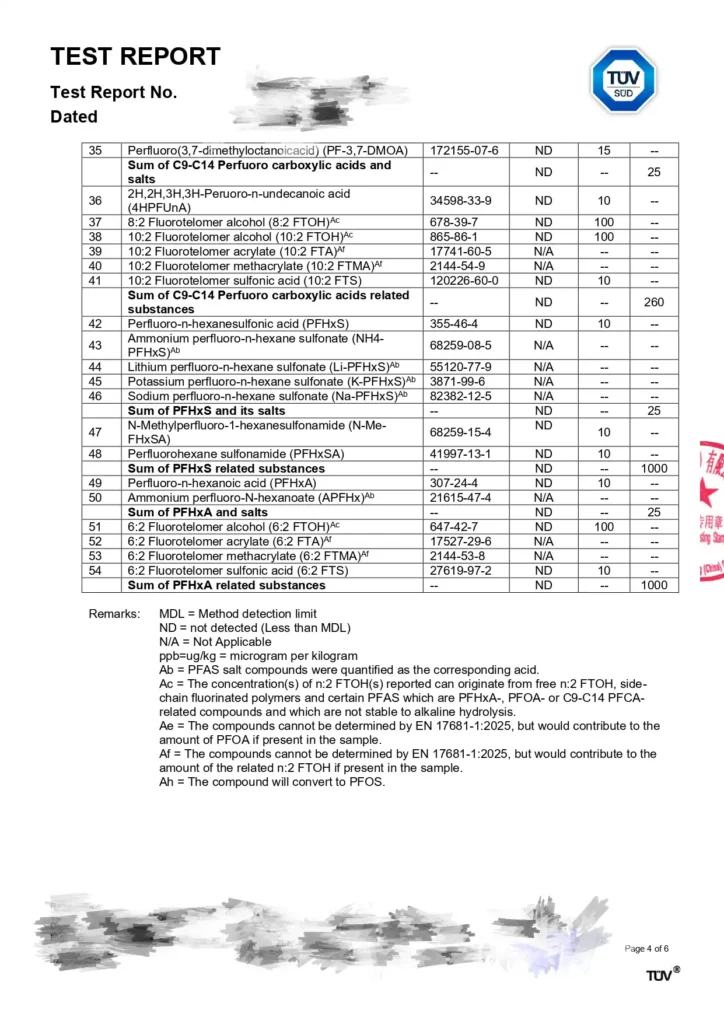
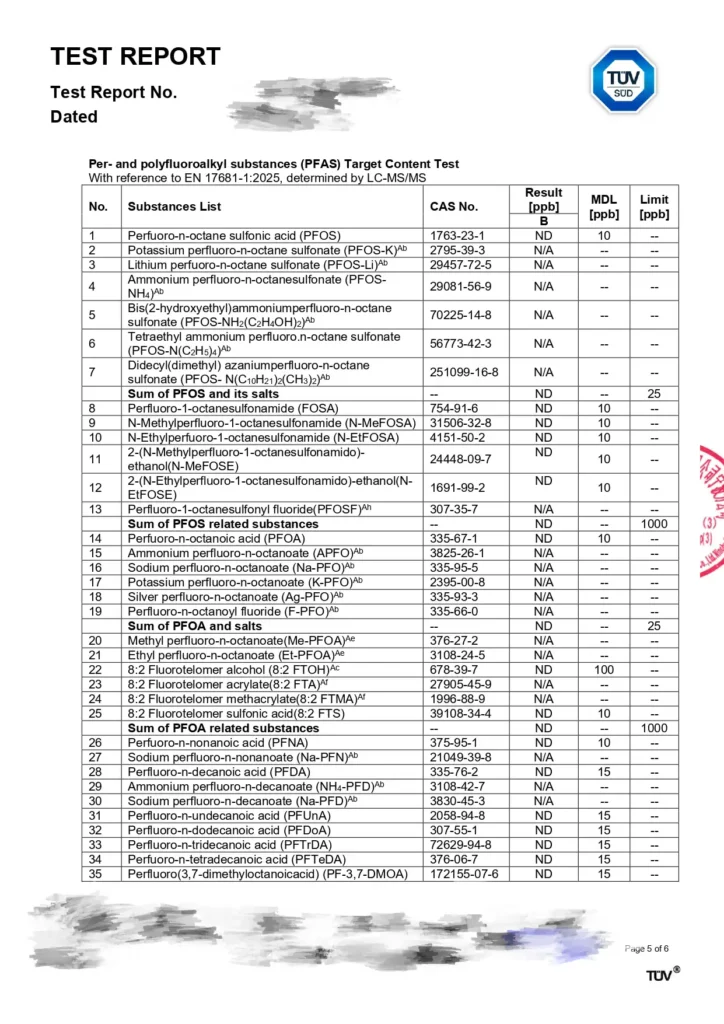
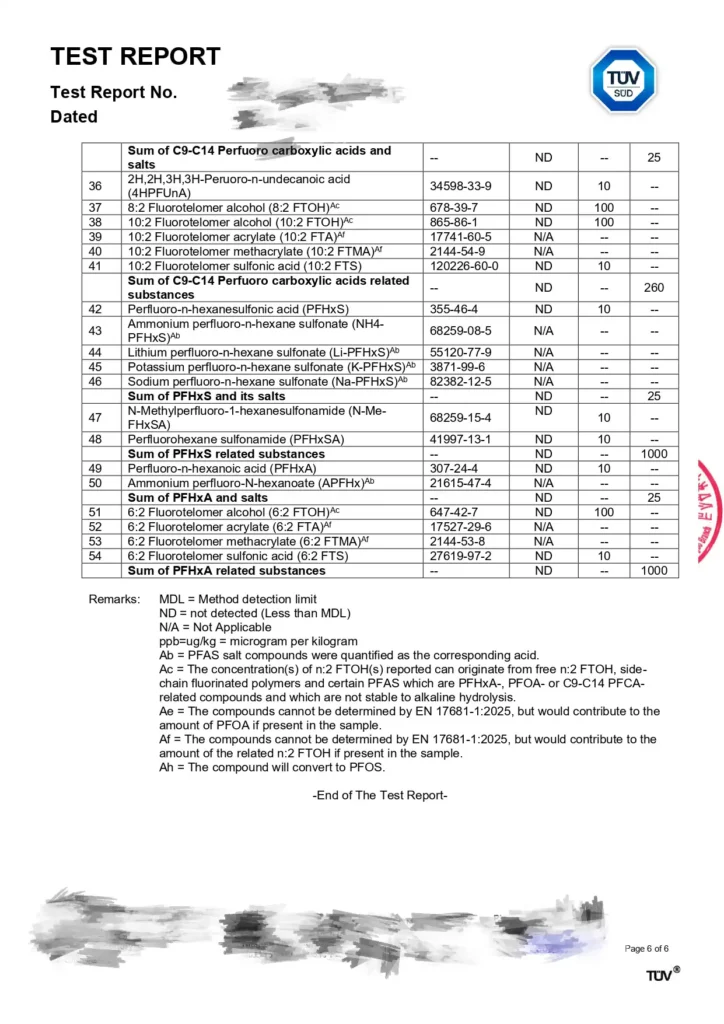
Representative TÜV SÜD Test Results
A representative TÜV SÜD PFAS Target Content Test covered two woven fabrics:
- 100% polyamide woven fabric
- 88% polyester / 12% spandex woven fabric
Testing was performed with reference to EN 17681-1:2025 using LC-MS/MS.
The report covered 54 listed PFAS substances and related entries. Both fabric samples received a Pass conclusion against the client’s specified requirements. The measurable target compounds and applicable grouped parameters were reported as ND — Not Detected, subject to the method detection limits stated in the report.
The report is representative of the tested samples only. It should not be interpreted as blanket certification of every fabric, production batch or possible PFAS substance.
How to Read a PFAS Test Report
ND Does Not Mean Absolute Zero
“ND” means that the measured concentration was below the method detection limit, or MDL, used for that specific substance.
It does not scientifically demonstrate that the concentration is exactly zero.
The Detection Limit Is Not the Same for Every Substance
In the representative TÜV SÜD report, method detection limits varied according to the target compound. They included 10 ppb, 15 ppb and 100 ppb values.
This is why CC Textile does not claim that every individual substance is below one universal 25 ppb limit.
What the 25 ppb Limit Means
In the representative report, the 25 ppb requirement applied to designated grouped parameters, including:
- Sum of PFOS and its salts
- Sum of PFOA and its salts
- Sum of C9–C14 perfluorocarboxylic acids and salts
- Sum of PFHxS and its salts
- Sum of PFHxA and its salts
Other related-substance groups had different limits specified in the report.
The 25 ppb value must therefore be connected to the relevant substance group and testing protocol. It should not be described as a universal limit for every PFAS compound.
What “Pass” Means
“Pass” means that the submitted samples met the client’s requirements stated in that particular report.
It does not mean that TÜV SÜD has certified every CC Textile product or the complete production facility.
Supporting European and US Market Requirements
PFAS requirements differ by destination market, product category and customer specification, and they continue to develop.
Before production, we work with the customer to confirm:
- Intended destination market
- Fabric composition and end use
- Required finish and performance
- Applicable restricted-substance requirements
- Target PFAS substance list
- Test method and reporting limits
- Preferred independent laboratory
- Required reports and production checkpoints
For regulatory background, buyers may refer to the EU Persistent Organic Pollutants legislation and the US EPA’s PFAS information.
Our process controls and third-party testing are designed to support the applicable customer and destination-market requirements. A fabric test report supports verification of the tested sample but does not replace the buyer’s legal assessment of the final consumer product.
PFAS-Controlled Fabric Development
The controlled route can be considered for selected nylon, polyester, stretch woven, jacquard, nylon/cotton, polyester/cotton and other functional apparel fabrics.
Available development options may include:
- Fluorine-free C0 DWR
- Moisture-management finishing
- Functional coating
- TPU lamination
- Stretch and recovery adjustment
- Custom composition, construction and GSM
- Customer-specified laboratory testing
Technical feasibility depends on the required construction, finish, performance level and end use.
Browse our current apparel fabric collection or review our custom fabric development services.
Information We Need for a PFAS-Controlled Project
To establish the appropriate production and testing plan, please provide:
- Fabric composition or reference sample
- Intended garment and end use
- Destination country or market
- Required DWR, coating, lamination or other finish
- Brand RSL or PFAS testing specification, if available
- Target substances and reporting limits
- Preferred testing laboratory
- Estimated quantity, colors and delivery schedule
CC Textile will review the requirement and confirm the practical fabric development, production-control and testing route.
[SEND YOUR PFAS FABRIC REQUIREMENT]
Link: https://cc-textile.com/contact/
Frequently Asked Questions
Can Any Supplier Prove That a Fabric Contains Absolutely Zero PFAS?
A targeted test cannot prove the absence of every possible PFAS compound. It can only report results for the submitted sample, listed target substances, analytical method and applicable detection limits.
A responsible claim should therefore define the testing scope and explain what “not detected” means.
What Does “No Intentionally Added PFAS” Mean?
It means PFAS are not deliberately used as ingredients in the yarns, dyes, auxiliaries, softeners, DWR agents or other chemical treatments specified for the project.
It does not automatically mean absolute zero because unintended trace contamination can originate from raw materials, water, equipment or the wider supply chain. This is why production controls and independent testing are both necessary.
How Are PFAS-Free Fabrics Tested?
Yes. CC Textile’s process includes third-party testing of the greige fabric before dyeing, the dyed fabric before finishing and the final finished fabric.
The exact test panel, method and reporting limits are determined according to the agreed project requirements.
Can We Specify the Testing Laboratory?
Yes. Customers may nominate a preferred laboratory. Where none is specified, CC Textile and the customer can agree on an appropriate independent provider, such as Intertek, SGS, Bureau Veritas or TÜV SÜD.
Does PFAS-Free C0 DWR Make a Fabric Waterproof?
No. DWR improves surface water repellency but does not by itself make a fabric waterproof.
Waterproof performance normally requires an appropriate coating or membrane lamination, seam construction and testing against the required hydrostatic-pressure standard.
Does One Passing Report Cover Every Future Production Batch?
No. A test report applies to the submitted samples and the production represented by those samples.
Each PFAS-controlled order follows its own agreed production and three-stage testing process.