Choosing the right fabric for down jackets is one of the most important decisions for garment brands. A shell fabric must provide reliable down-proof protection while maintaining lightweight performance, durability, and production stability.
A fabric may look lightweight, soft, and attractive during the sampling stage. However, if it cannot control down leakage after sewing, washing, and daily use, the final product can create serious quality problems.
For sourcing managers, the question is not simply:
“Which fabric is the thinnest?”
The real question is:
“Which fabric construction can provide the right balance between lightweight performance, down-proof protection, durability, and production reliability?”
Common shell fabric options for down jackets include:
- 20D nylon
- 40D nylon
- 70D nylon
- Lightweight polyester fabrics
Each option has different characteristics. Understanding these differences helps brands avoid costly production problems and select the right material for their target market.
Why Fabric Selection Matters for Down Jackets
Unlike ordinary jackets, down jackets require special fabric structures because the filling material is extremely lightweight and can move through very small gaps between yarns.
A suitable fabric for down jackets needs to control several factors:
- Down leakage resistance
- Fabric density
- Weight and comfort
- Sewing performance
- Washing durability
- Production consistency
Many buyers focus only on appearance and price during the development stage. However, the fabric construction determines whether the garment will perform well after thousands of pieces enter the market.
For example, a shell fabric may feel excellent in a sample room but fail after washing because the yarn gaps become more noticeable or sewing holes allow feathers to escape.
Therefore, down jacket fabric selection requires both laboratory testing and practical production experience.
Fabric for Down Jackets: 20D, 40D and 70D Nylon Differences
Nylon is one of the most widely used materials for down jacket shells because it combines lightweight performance with good strength.
The main difference between 20D, 40D, and 70D nylon is the yarn thickness and fabric construction.
20D Nylon Fabric for Lightweight Down Jackets
20D nylon uses very fine yarns.
The thinner yarn creates several advantages:
- Lightweight construction
- Soft hand feel
- Smooth surface appearance
- Comfortable wearing experience
Because of these characteristics, 20D nylon is commonly used for:
- Premium lightweight down jackets
- Packable outdoor jackets
- Travel-focused outerwear
However, thin yarn also creates higher technical requirements.
A 20D fabric usually needs better control of:
- Fabric density
- Weaving process
- Finishing technology
Without proper construction, the fabric may have higher risk of down leakage.
For this reason, lightweight fabrics often require additional down-proof treatment before they can be used in direct-fill down jackets.
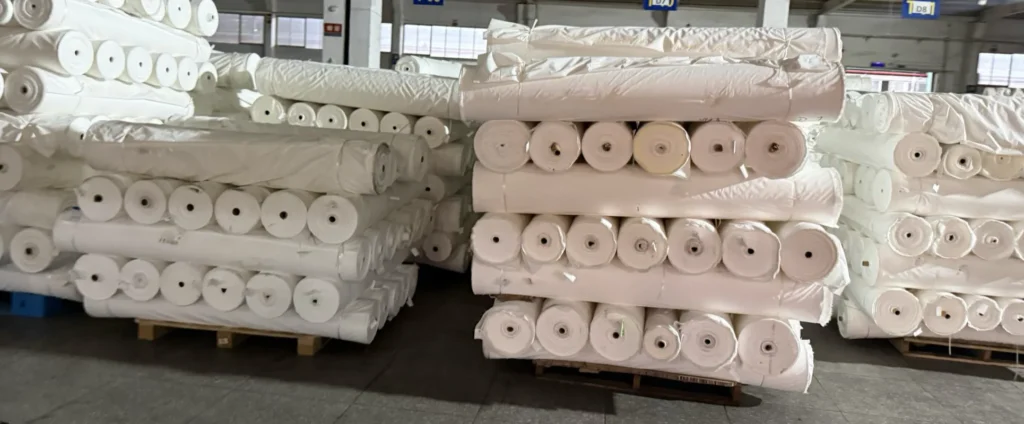
40D Nylon Fabric: A Balanced Choice for Commercial Outerwear
40D nylon provides a balance between lightweight performance and durability.
Compared with 20D nylon, it usually offers:
- Stronger fabric structure
- Better abrasion resistance
- Easier production handling
This makes it suitable for many commercial down jackets and outdoor products.
For brands looking for a balance between cost, durability, and customer comfort, 40D nylon is often a practical choice.
It provides enough strength for daily use without creating excessive garment weight.
70D Nylon Fabric: More Protection and Durability
70D nylon uses a thicker yarn construction.
Typical advantages include:
- Higher mechanical strength
- Better abrasion resistance
- More substantial hand feel
It is often selected for:
- Outdoor lifestyle jackets
- Work-oriented outerwear
- Products requiring stronger protection
The trade-off is that higher denier fabrics usually increase:
- Fabric weight
- Material consumption
- Garment weight
Therefore, 70D nylon may not be the first choice for ultralight down jackets where weight reduction is a major selling point.
Can Polyester Fabric Be Used for Down Jackets?
Polyester is another option for down jacket shells.
It can provide:
- Stable color performance
- Good appearance
- Competitive material cost
However, very lightweight polyester fabrics may have different challenges compared with nylon.
One common concern is wrinkling.
Thin polyester constructions can sometimes show more visible wrinkles because of:
- Fiber characteristics
- Fabric construction
- Finishing process
This does not mean polyester cannot be used for down jackets.
A properly developed polyester shell fabric can still perform well when combined with:
- Suitable density
- Appropriate finishing
- Correct fabric construction
The final performance depends on the complete fabric system rather than fiber composition alone.
What Makes Fabric for Down Jackets Down-Proof and Reliable?
A suitable shell fabric must pass specific performance requirements before bulk production.
The most important factor is down-proof performance.
Down-Proof Protection
Down-proof means preventing feathers and down clusters from passing through the fabric structure.
There are two main leakage areas:
Fabric Body Leakage
This happens when down moves through the gaps between warp and weft yarns.
The solution usually involves:
- Higher fabric density
- Coating treatment
- Calendering process
Sewing Leakage
This occurs around needle holes created during garment production.
Even a fabric with good down-proof performance may experience leakage if sewing parameters are not controlled.
Important factors include:
- Needle size
- Stitch density
- Sewing process
- Production quality control
Therefore, testing should evaluate both fabric performance and finished garment performance.
How Fabric for Down Jackets Achieves Down-Proof Performance
There are three common methods used to improve down-proof performance.
1. Coating Treatment
Coating is one of the most common solutions.
The process is similar to applying a very thin adhesive layer onto the fabric surface.
This layer fills small gaps between yarns and reduces the possibility of down leakage.
Advantages:
- Effective protection
- Suitable for lightweight fabrics
- Cost-efficient solution
However, coating needs careful control.
An overly heavy coating may affect:
- Fabric hand feel
- Breathability
- Softness
The coating level must match the final product requirements.
2. Calendering Process
Calendering uses high temperature and pressure to compress the fabric surface.
During this process:
- Yarn structures become flatter
- Small gaps between yarns are reduced
- Fabric becomes more compact
This method can improve down-proof performance while maintaining a lightweight feeling.
It is often used for thin shell fabrics where maintaining softness is important.
3. High-Density Direct Fill Fabric
Some premium down jackets use fabrics that achieve down-proof performance through extremely high fabric density.
Instead of relying mainly on coating, the fabric itself creates a tighter barrier.
Advantages:
- Natural soft hand feel
- Lightweight construction
- Premium appearance
However, high-density fabrics require:
- Better weaving control
- Higher production precision
- More careful quality management
As a result, they usually have a higher material cost.
Fabric for Down Jackets: Shell Fabric vs Down Bag Construction
Not all down jackets require the shell fabric itself to provide complete down-proof performance.
The construction method changes the fabric requirements.
Direct Fill Down Jackets (No Down Bag)
In a direct-fill construction, down is filled directly into the jacket compartments.
The shell fabric must provide strong down-proof protection.
Advantages:
- Lightweight
- Less bulky
- Premium wearing experience
Challenges:
- Higher fabric requirements
- More strict production control
- Higher material cost
Down Jackets With Inner Lining or Down Bag
Some jackets use an additional inner fabric layer to contain the down.
In this construction:
- The inner fabric provides down-proof protection
- The outer fabric focuses more on appearance and durability
Advantages:
- More flexible shell fabric selection
- Lower risk of down leakage
The disadvantage is additional layers increase:
- Weight
- Thickness
- Production steps
Common Mistakes When Selecting Down Jacket Fabrics
Mistake 1: Choosing Fabric Only by Price
The cheapest fabric may create higher costs later through:
- Customer complaints
- Returns
- Rework
A small saving in fabric cost can become a much larger quality problem.
Mistake 2: Testing Only Before Washing
A fabric that passes an initial test may still fail after washing.
Before bulk approval, brands should evaluate:
- Down leakage after washing
- Fabric appearance changes
- Sewing performance
Mistake 3: Ignoring Sewing Performance
Many down leakage problems happen at sewing points.
Fabric selection should always consider:
- Needle selection
- Stitch density
- Production process
A good fabric needs to work together with the garment manufacturing process.
Q&A: Common Questions About Down Jacket Fabrics
Q: What is the best fabric for down jackets?
Answer:
There is no single best fabric for all down jackets. 20D nylon is suitable for lightweight premium products, while 40D and 70D nylon provide stronger durability and easier production control.
The correct choice depends on the jacket design, target market, and required performance.
Q: Why does a down jacket leak feathers?
Answer:
Down leakage can happen because of insufficient fabric density, unsuitable finishing, or sewing holes created during production.
A fabric should be tested after washing and evaluated together with the garment construction before bulk production.
How to Select the Right Fabric Before Bulk Production
Before approving a fabric for down jacket production, sourcing teams should review:
- Fabric weight
- Yarn construction
- Density
- Down-proof test results
- Washing performance
- Sewing compatibility
A successful down jacket depends on the cooperation between fabric structure and garment manufacturing.
CC Textile helps brands develop suitable shell fabrics and connect material selection with practical production requirements through professional custom fabric solutions.
For brands requiring complete apparel development support, understanding the relationship between fabric performance and manufacturing process is equally important. CC Textile provides integrated support through its garment production workflow.
More information about the company’s textile experience and production capabilities is available through the CC Textile company profile.
Final Thoughts
Choosing the right fabric for down jackets is not simply about selecting the lightest or cheapest material.
A successful shell fabric needs the right balance of:
- Weight
- Density
- Down-proof performance
- Hand feel
- Production stability
Whether using 20D nylon, 40D nylon, 70D nylon, or lightweight polyester, the fabric must pass real performance testing before entering bulk production.
For down jacket brands, preventing down leakage before products reach customers is far more cost-effective than solving quality problems after shipment.
Follow CC Textile’s textile development updates and sourcing insights on LinkedIn and Facebook.
#DownJacketFabric #TextileSourcing #OuterwearFabrics #GarmentManufacturing #FunctionalFabrics