A U.S. customer recently came to us with a hunting-jacket development that looked straightforward on paper.
They wanted a high-stretch Multifunctional Outdoor Fabric combining:
Camouflage + UPF 50+ + C0 DWR + Repel Mosquito® + Stretch
None of these functions was new to us. We already work with Nylon, Polyester, Nylon/Spandex and Polyester/Spandex constructions for hunting, hiking, fishing and other outdoor apparel.
The problem appeared when we tried to put everything together.
The fabric could meet the functional direction, but after printing, the hand feel became noticeably too stiff for the customer’s hunting jacket.
That changed the development from “Can we add these functions?” to a much more useful question:
In what order should these processes be applied so that one function does not compromise the rest of the fabric?
Lesson 1: Passing Individual Functions Is Not Enough
This is one of the traps with Multifunctional Outdoor Fabric.
A sourcing sheet may ask for UPF 50+, water repellency, mosquito protection, camouflage and stretch as five separate lines. On the production floor, however, they are not five separate fabrics.
They all have to work on the same Multifunctional Outdoor Fabric without sacrificing the hand feel and mobility required by the finished garment.
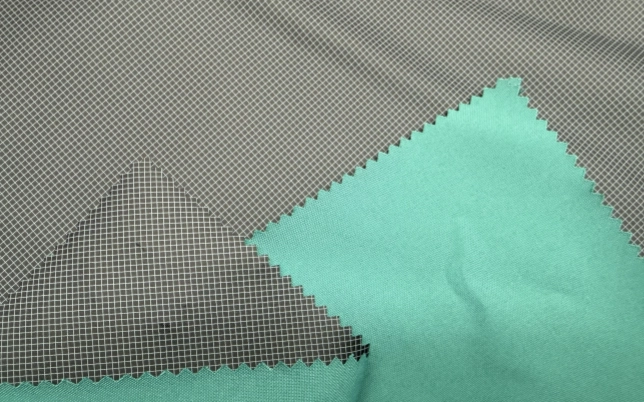
For this U.S. project, the base fabric was a high-stretch outdoor construction intended to provide the mobility required for hunting apparel. The camouflage also needed good colorfastness, while the finished fabric had to retain the customer’s specified UV protection, water repellency and mosquito-repellent performance.
Our camouflage developments can work with customer-supplied artwork using digital or transfer printing, depending on the construction. For stretch fabrics, we also develop both 2-way and 4-way stretch directions, with projects requiring camouflage colorfastness of Grade 4 or above.
The first trial made one thing clear: checking each specification separately would not be enough.
The finished hand feel had to be treated as part of the technical specification.
Lesson 2: The Problem Was the Processing Sequence
During the first trial, our Multifunctional Outdoor Fabric became noticeably stiffer after camouflage printing, even though the individual functional requirements were moving in the right direction.
Instead of trying to correct the problem by simply adding another treatment, we went back to the production sequence and evaluated how the different processes were interacting with the fabric.
The practical solution was to change the order.
For this project, the required functional treatment was completed before the camouflage printing stage. After adjusting the sequence, the finished fabric achieved the hand feel expected by the customer while maintaining the required functional direction.
This sounds like a small production change. It was not.
When several functions are being developed into one Multifunctional Outdoor Fabric, the order of printing and finishing can influence the final hand, stretch behavior and functional performance. A route that works for a conventional camouflage fabric cannot automatically be copied to a fabric carrying several additional functions.
We also would not present this sequence as a universal formula.
It worked for this construction, this printing route and this customer’s specification. A different substrate or function combination may require a different process.
That distinction matters when moving from sample development to bulk production.
Lesson 3: C0 DWR, UPF 50+ and Mosquito Repellency Have Different Jobs
Once we had the processing route for the Multifunctional Outdoor Fabric under control, each function still had to meet the customer’s individual performance target.
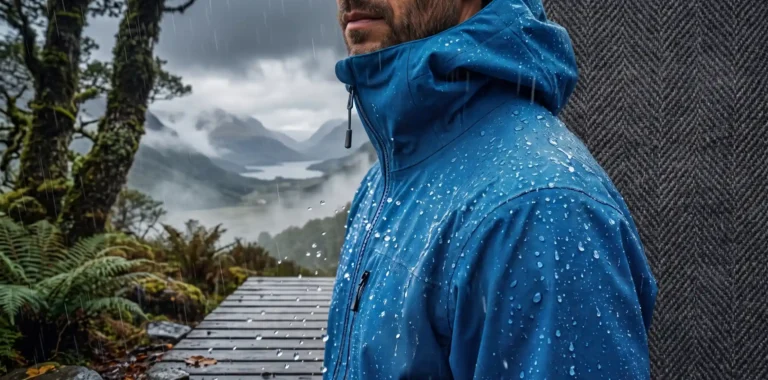
For C0 DWR developments, our customer requirements can call for an initial water-repellency rating of Grade 3.5–4 or above, with Grade 3 or above after 10 washes, depending on the project.
We deliberately call this water repellency, not waterproofing.
C0 DWR—or terminology such as non-PFAS / fluorine-free water-repellent finishing used in customer sourcing documents—is designed to reduce surface wetting. It is not the same as hydrostatic waterproof performance created by a membrane or coating.
UV protection is another separate development route. Depending on the customer’s project, we can work with yarn carrying inherent UV-protection characteristics or an appropriate additive/finishing solution to reach the required UPF performance.
Mosquito repellency has its own durability requirement. For projects we have worked on, Repel Mosquito® fabric can be developed around 80- or 100-wash requirements, according to the customer’s specification.
The important part is that these specifications still have to work after they are combined, not merely when evaluated individually.
This is why developing Multifunctional Outdoor Fabric is less about adding individual finishes and more about making sure they remain compatible after printing, finishing and washing.
Lesson 4: Stretch and Hand Feel Need to Be Checked Last, Not First
This Multifunctional Outdoor Fabric project reinforced another point that sourcing teams can easily overlook: stretch and hand feel should be evaluated after the complete finishing and printing process.
Do not approve a stretch outdoor fabric based only on the untreated or partially processed sample.
If the final garment requires camouflage, DWR, UV protection and mosquito repellency, the material that matters is the one coming off the end of the complete production route.
A base fabric may begin with excellent stretch and a soft hand. Printing and multiple finishing processes can change that.
For a 4-way stretch camouflage fabric, for example, we would want to know not only whether it stretches before finishing, but how the finished material behaves after the required processes have been completed.
That means checking the characteristics that matter to the garment—hand feel, stretch/recovery, colorfastness and the specified functional performance—on the final developed fabric.
The first trial of our U.S. hunting project showed exactly why.
The technical specification cannot end with chemistry. Someone still has to wear the jacket.
Lesson 5: We Don’t Release Bulk Fabric Before the Required Test Results
After the processing sequence was adjusted and the fabric development was completed, the project moved to testing.
For these functional developments, we can work with independent laboratories such as SGS, Intertek (ITS), Bureau Veritas (BV), or another laboratory appointed by the customer.
We do not publish a single test standard for every project because different customers, functions and markets can specify different methods.
For this U.S. hunting-jacket order, the finished fabric was tested against the customer’s required specifications.
For Multifunctional Outdoor Fabric, we prefer final testing to represent the actual finished construction rather than an unfinished base fabric or an intermediate production stage.
We waited for the required test reports before releasing the fabric for shipment.
The order moved forward only after the results confirmed that the finished material met the customer’s requirements.
For us, that final step is part of development—not paperwork added after development is finished.
What This Hunting Jacket Project Actually Taught Us
The most interesting part of this project was not that one fabric could carry several functions. We already knew that was technically possible.
The useful lesson was how quickly those functions could begin to interfere with the character of the base fabric.
The development route effectively became:
High-Stretch Base Fabric → Functional Processing → Camouflage Printing → Final Hand & Performance Evaluation → Third-Party Testing → Bulk Shipment
The original issue appeared in the relationship between processing sequence and hand feel. Once that was corrected, we could validate the complete material rather than trying to judge UPF, DWR, mosquito repellency, camouflage and stretch as unrelated specifications.
This is how we prefer to approach a custom hunting jacket fabric.
Start with the garment. Determine what it actually needs. Then develop the processes as one system.
Sourcing Notes: 5 Questions to Ask Before Developing a Multifunctional Fabric
For sourcing and materials teams working on hunting, hiking, fishing or camping apparel, these are the questions we would settle before bulk development:
When sourcing Multifunctional Outdoor Fabric, buyers should define the finished-garment requirements before discussing individual treatments with the mill.
| Ask Before Development | Why It Matters |
|---|---|
| What does the finished garment actually need? | Prevents unnecessary finishes and conflicting requirements |
| Is the fabric 2-way or 4-way stretch? | Printing and finishing must preserve required mobility |
| What durability is required after washing? | Initial DWR or mosquito performance tells only part of the story |
| In what sequence will printing and finishing be applied? | Process interaction can change hand feel and performance |
| When will the finished fabric be independently tested? | Final approval should represent the actual bulk construction |
For mosquito-repellent programs, specify the required wash durability—such as 80 or 100 washes—at the beginning rather than after sampling.
For C0 DWR, define both the initial water-repellency target and the required result after washing.
For UPF, tell the mill the actual target—such as UPF 50+—rather than simply asking for “UV protection.”
And for camouflage stretch fabric, approve the finished hand and stretch, not only the artwork.
One Fabric, Several Functions—but One Development Process
We develop Multifunctional Outdoor Fabric using Nylon, Polyester, Nylon/Spandex and Polyester/Spandex bases for hunting clothing, hiking pants, outdoor jackets, fishing clothing, tactical/workwear and camping apparel.
Depending on the project, development can combine customer camouflage artwork, digital or transfer printing, 2-way or 4-way stretch, UPF protection, C0 DWR and durable mosquito-repellent functionality.
But we do not start by asking:
“How many functions can we add?”
The more useful question is:
“Which functions does this garment need, and in what sequence can we build them without losing the character of the base fabric?”
That is the difference between adding finishes and developing a performance textile.
Explore our functional fabric collection and custom fabric development capabilities.
If you are developing Multifunctional Outdoor Fabric for a hunting, hiking or other outdoor program, contact CC Textile with your base-fabric specification, stretch requirement, artwork, UPF target, C0 DWR wash requirement, mosquito-repellent durability and testing expectations.
Final Thoughts
Our U.S. hunting-jacket project started with a demanding but reasonable specification: camouflage, UPF 50+, C0 DWR, mosquito repellency and high stretch in one fabric.
The difficult part was not achieving each function independently. It was maintaining the right fabric character after all the processes were combined.
When the first printed trial became too stiff, changing the processing sequence solved the problem. The final material was then independently tested against the customer’s requirements, and we released the order only after receiving the required test results.
That is the part of Multifunctional Outdoor Fabric development that a specification sheet rarely shows.
The recipe matters. The sequence matters. And the finished fabric—not the unfinished base—is what ultimately needs to pass.
Learn more about CC Textile or read more of our technical fabric development articles.
For sourcing and fabric-development discussions, you can also connect with CC Textile on LinkedIn.
MultifunctionalOutdoorFabric #HuntingFabric #FabricSourcing #PerformanceTextiles #OutdoorApparel