PFAS in Textiles: 7 Proven Steps for EU Compliance
PFAS in textiles is becoming a critical sourcing and compliance issue for apparel brands selling into the European market.
But from our experience in fabric development, changing from a traditional fluorinated water-repellent finish to C0 DWR is only part of the solution.
When limits are measured in parts per billion, buyers also need to think about water, chemicals, machinery, production lines and possible cross-contamination.
This is why we prefer a practical approach:
Control the production process, test at different stages, and verify the finished fabric with data.
What Are PFAS in Textiles?
PFAS stands for per- and polyfluoroalkyl substances, a large family of synthetic fluorinated chemicals.
Some fluorinated chemistries have historically been used in textiles to achieve properties such as:
- Water repellency
- Oil repellency
- Stain resistance
For European apparel sourcing, one important regulation already adopted concerns PFHxA, its salts and PFHxA-related substances.
From October 10, 2026, relevant clothing and related accessories for the general public must be below the applicable limits in homogeneous material:
- PFHxA and its salts: below 25 ppb
- PFHxA-related substances: below 1,000 ppb
For buyers, this makes PFAS control a supply-chain issue rather than simply a finishing issue.
Step 1: Use C0 Water-Repellent Chemistry
When customers require water repellency, we use C0 water-repellent solutions rather than intentionally using fluorinated DWR chemistry.
C0 DWR is not limited to one specific type of apparel.
We develop it according to the customer’s requirements for water repellency, fabric construction, hand feel and final application.
However, using C0 chemistry alone does not automatically guarantee that the finished fabric will meet every PFAS requirement.
The complete production process still needs to be controlled.
Step 2: Control the Water Used in Production
This is one of the areas we pay particular attention to.
For relevant controlled orders, our dyeing mill uses distilled water supplied by a thermal power plant in processes where water is required.
We do not rely on recycled process water for these controlled dyeing and finishing operations.
Why?
Because when testing is performed at very low concentrations, controlling the finishing chemical alone is not enough. Water can also become part of the contamination-control discussion.
At the weaving stage, we can use air-jet weaving. Where natural river water is used in relevant textile processes, the used water is collected and sent to a wastewater treatment facility rather than being directly discharged.
Step 3: Use Dedicated PFAS-Controlled Equipment
Cross-contamination is another risk buyers should not overlook.
Even if a new fabric uses C0 water-repellent chemistry, equipment previously exposed to fluorinated chemistry may create an unwanted contamination risk.
For relevant PFAS-controlled orders, we therefore use:
- Dedicated equipment
- A separate production line
- Controlled processing procedures
The purpose is simple: reduce the possibility of cross-contamination before it becomes a testing problem.
This is also why we believe asking only, “Do you use C0 DWR?” is not enough.
A better question is:
“How do you control PFAS contamination throughout production?”
You can learn more about our custom fabric development services.
Step 4: Test the Greige Fabric First
We don’t want to discover a problem only after the fabric has been completely finished.
Our first testing checkpoint is therefore the greige fabric.
This gives us a baseline before dyeing and functional finishing begin.
If the greige fabric meets the required criteria but a later stage does not, we have a much clearer starting point for investigating where the issue may have been introduced.
Step 5: Test Again After Dyeing
Our second checkpoint is the dyed fabric.
Dyeing introduces additional variables into production, including:
- Water
- Dyes
- Auxiliary chemicals
- Processing equipment
Testing after dyeing allows us to check the material again before functional finishing.
For us, this staged approach provides better traceability than relying on only one final test.
Step 6: Test After C0 Finishing
The third checkpoint is the finished fabric.
After dyeing and the required functional finishing are completed, the fabric is tested again.
Our basic control sequence is therefore:
Greige Fabric → Dyed Fabric → Finished Fabric
This three-stage approach helps us identify potential issues earlier and provides more useful information when tracing the production process.
Explore our functional fabric solutions.
Step 7: Let the Customer’s Laboratory Verify the Final Fabric
Internal testing is only part of our process.
After our three-stage testing, the finished fabric can be sent to the third-party laboratory specified by the customer for final verification.
We can work according to the testing requirements agreed with the customer.
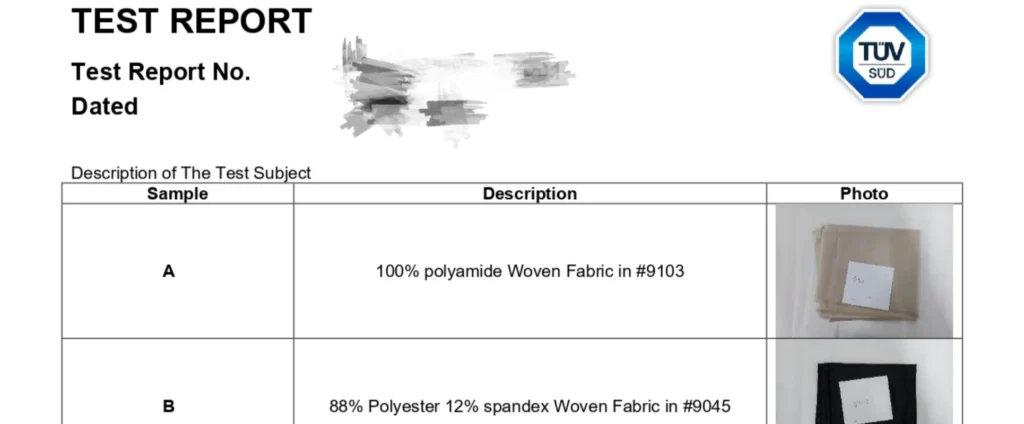
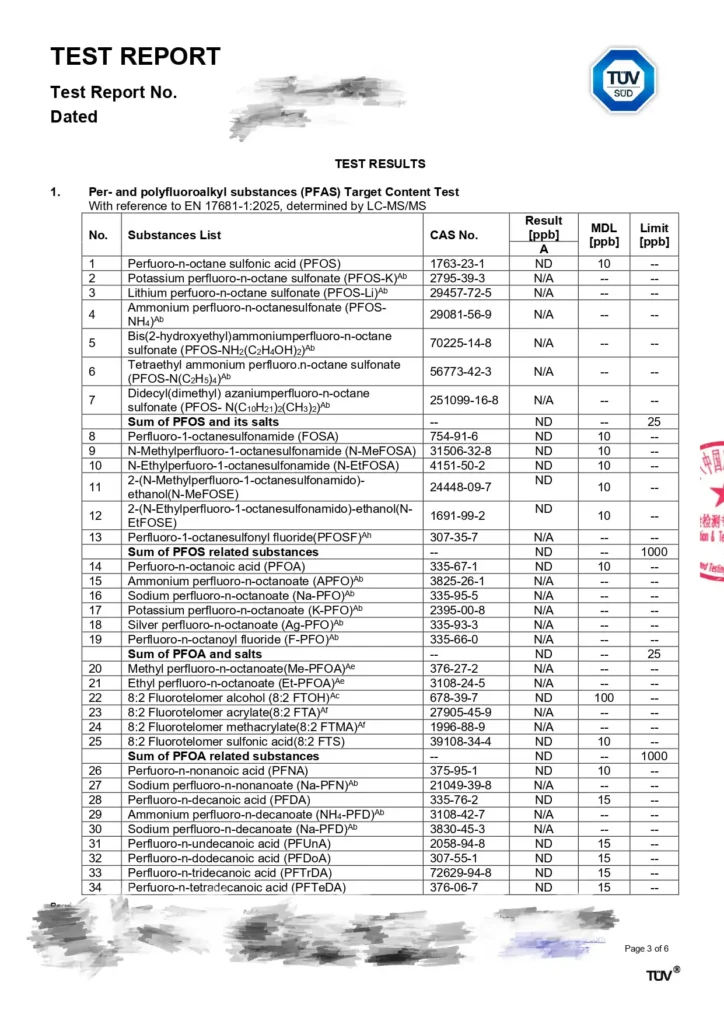
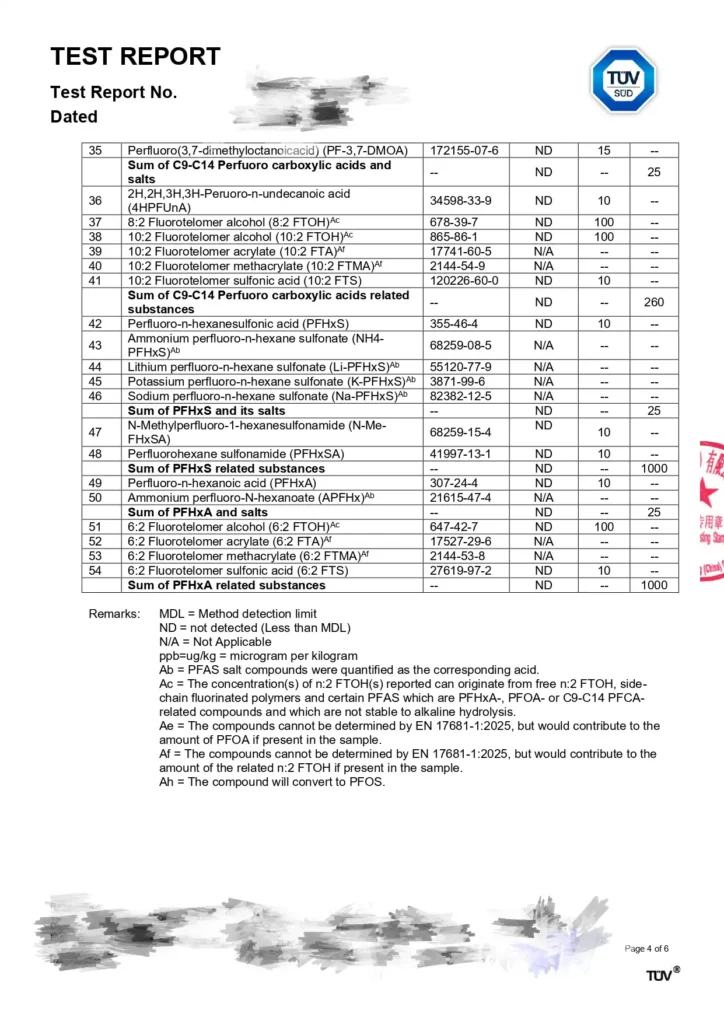
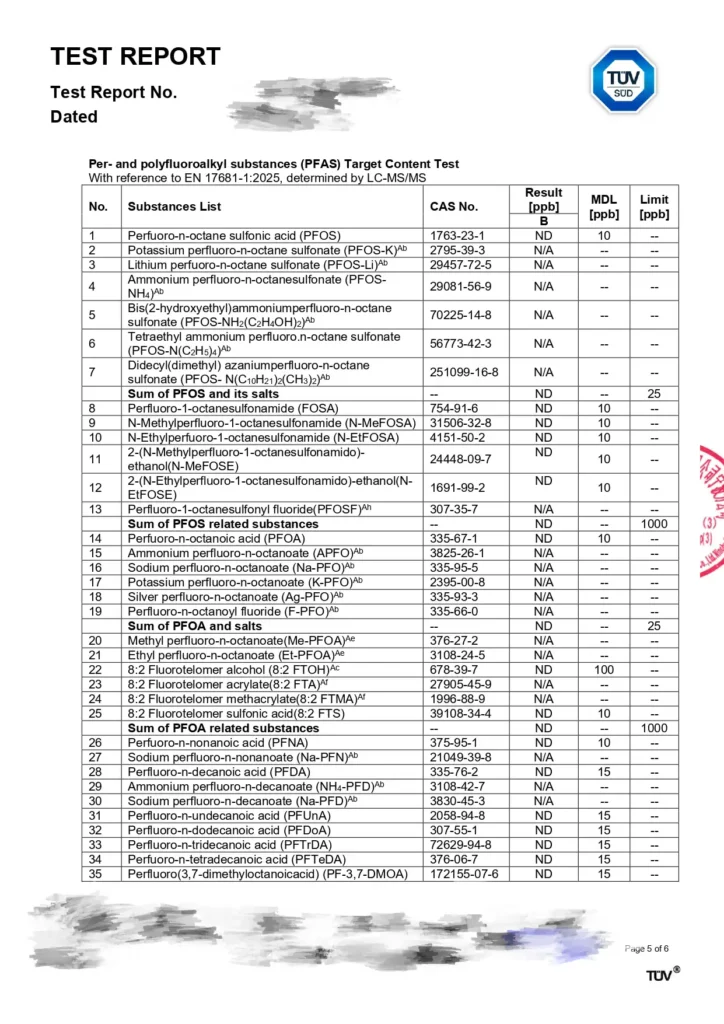
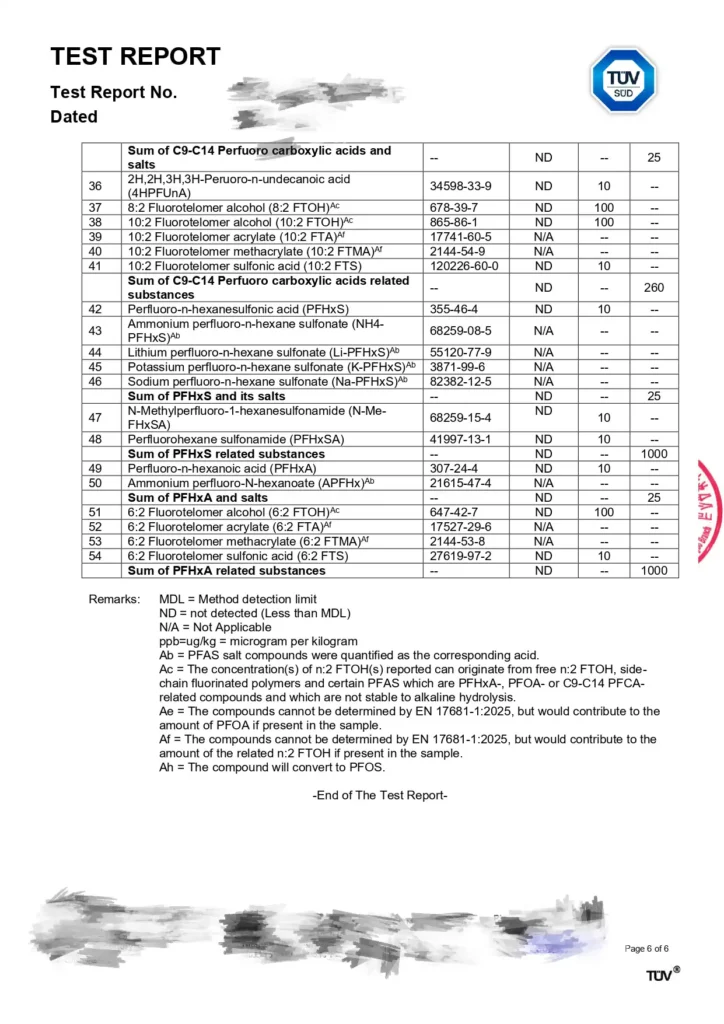
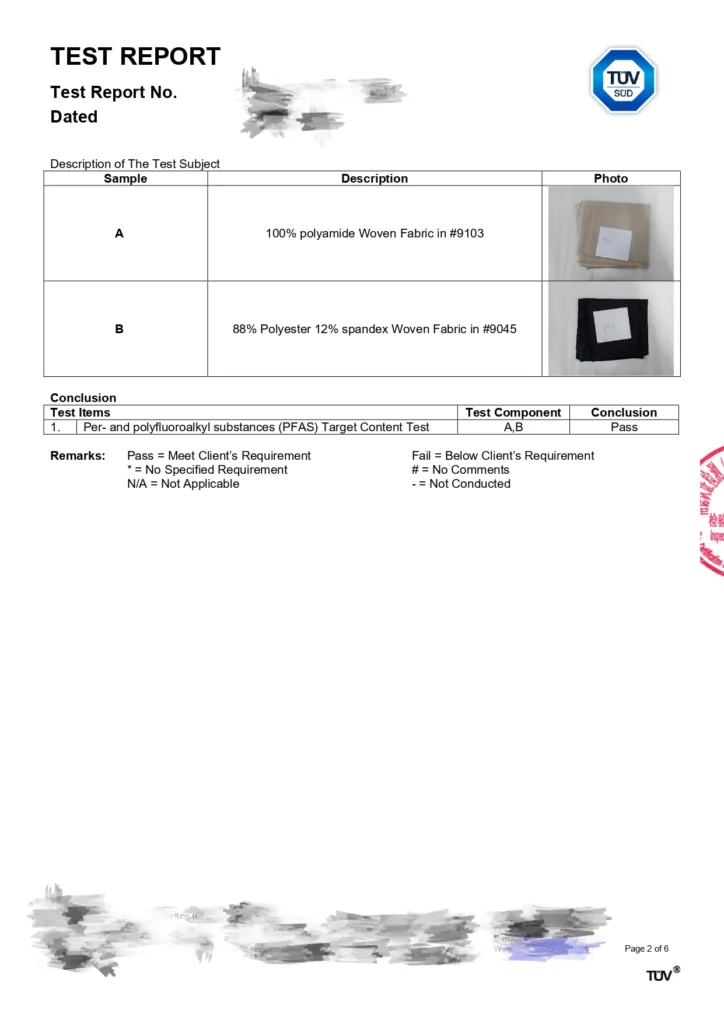
[Insert your actual third-party PFAS test report here]
For a sourcing or compliance manager, we believe an actual test report is more useful than a simple marketing claim saying “PFAS-free.”
Why We Don’t Promise “Absolutely Zero Fluorine”
This is an important distinction.
In a complex textile supply chain, we don’t believe it is responsible to casually promise that a finished fabric contains absolutely zero fluorine.
Instead, we focus on what we can control and verify:
- No intentionally added fluorinated DWR in relevant C0 developments
- C0 water-repellent chemistry
- Controlled water sources
- Dedicated PFAS-controlled equipment
- Separate production lines
- Testing at greige, dyed and finished stages
- Final verification by the customer’s nominated laboratory
For the applicable EU PFHxA requirement, our goal is to provide fabrics supported by test data showing compliance with the relevant limits, including the 25 ppb limit for the sum of PFHxA and its salts where applicable.
The difference is important:
A claim is marketing. A test result is evidence.
What Should Apparel Buyers Ask Their Fabric Supplier?
When sourcing PFAS-controlled fabrics for the European market, these are some of the questions we believe buyers should ask.
Is the water-repellent finish C0?
Confirm whether intentionally added fluorinated DWR chemistry is being used.
How is cross-contamination controlled?
Ask about machinery, production lines, water sources and processing procedures — not just the finishing chemical.
When is the fabric tested?
Testing only the finished fabric may tell you whether there is a problem, but not necessarily where it originated.
A staged testing process provides better traceability.
Can we nominate the final testing laboratory?
For compliance-sensitive orders, buyers should be able to verify the finished fabric through their preferred qualified laboratory.
Can the supplier provide actual test reports?
Whenever possible, ask for evidence rather than relying solely on terms such as “PFAS-free” or “fluorine-free.”
FAQ: PFAS in Textiles
What does PFAS mean in textiles?
PFAS are a large group of fluorinated chemicals. Some fluorinated chemistries have historically been used in textile finishing for water, oil and stain repellency.
Is C0 DWR the same as PFAS-free?
Not necessarily.
C0 refers to the water-repellent chemistry being used. The finished fabric can still require contamination control and laboratory testing because other parts of the production process may influence the final result.
What does the EU 25 ppb PFAS limit mean?
For the relevant EU PFHxA restriction applying from October 10, 2026, the limit is 25 ppb for the sum of PFHxA and its salts in homogeneous material.
There is a separate 1,000 ppb limit for the sum of PFHxA-related substances.
Therefore, “25 ppb” should not be interpreted as a universal limit covering every PFAS substance.
Why test greige, dyed and finished fabric separately?
Testing at different stages improves traceability.
If the greige fabric passes but the dyed or finished fabric does not, the production team has a much clearer idea of where to investigate.
Can you guarantee that fabric contains absolutely no fluorine?
We prefer not to make an absolute zero-fluorine claim.
Our approach is to control relevant chemistry and production risks, use dedicated equipment and production lines, test throughout production, and verify finished fabrics against the customer’s applicable requirements.
Can C0 water-repellent performance be customized?
Yes.
C0 water repellency can be developed according to the customer’s fabric construction, performance requirements and final application. It is not limited to one specific clothing category.
For custom development, contact CC Textile.
Final Thoughts
Managing PFAS in textiles for the European market requires more than replacing one finishing chemical.
From our production experience, the process needs to consider:
Water → Equipment → Dyeing → C0 Finishing → Cross-Contamination → Testing
Our approach is straightforward: use C0 water-repellent chemistry when required, control water and equipment, separate relevant production, test the fabric at three stages, and allow the customer’s nominated laboratory to verify the final material.
For apparel buyers, the most valuable question may no longer be:
“Is this fabric PFAS-free?”
A better question is:
“How do you control, test and verify PFAS compliance?”
Learn more about CC Textile or visit our latest textile insights.
Follow CC Textile on LinkedIn and Instagram.
#PFASinTextiles
#C0DWR
#TextileCompliance
#FunctionalFabric
#SustainableTextiles