Jacket Fabric: 7 Proven Tips for Better Performance
Jacket fabric selection usually starts with a simple question from the customer:
“What fabric would you recommend for this jacket?”
But before recommending nylon, polyester, a coating or a membrane, we normally need to know what the finished jacket is expected to do.
A lightweight windbreaker, an outdoor shell, a softshell jacket and a workwear jacket may all be called “jackets,” but their fabric requirements can be very different.
In our development work, we usually start with three questions:
What is the jacket used for? What performance is required? What weight and hand feel is the brand trying to achieve?
Only then do we start selecting the fiber, yarn size, fabric construction and finishing.
What Fabric Is Best for Jackets?
There isn’t one best fabric for every jacket.
For most of the jacket projects we work on, woven fabrics are the main choice, although knitted fabrics can also be used for specific constructions and applications.
Common fiber options include:
- Polyester
- Nylon
- Recycled polyester
- Polyester/Spandex
- Nylon/Spandex
The choice depends on the balance required between weight, durability, stretch, hand feel, cost and protection.
1. Nylon Jacket Fabric: A Good Choice for Lightweight Performance
For lightweight and outdoor jacket development, nylon is one of the materials we frequently work with.
A typical development may start with:
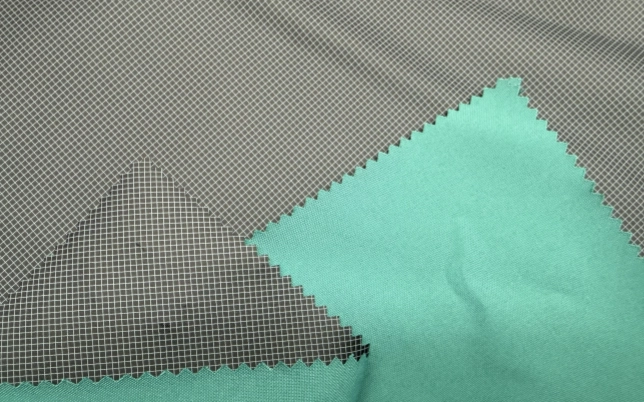
40D or 70D Nylon
Around 100–120 GSM
Twill construction
Why nylon?
It can offer a useful combination of:
- Lightweight construction
- Tear resistance
- Abrasion resistance
- Soft hand feel
- Good strength-to-weight performance
Depending on the jacket requirement, we can then add C0 DWR, a coating or a TPU membrane.
For example, a lightweight outdoor jacket may use a 40D or 70D nylon shell when the buyer wants to keep the garment light while maintaining reasonable durability and weather protection.
2. Polyester Jacket Fabric: More Options for Structure and Weight
Polyester gives product developers a wide range of possibilities.
Typical constructions we work with include:
75D or 150D Polyester
Around 120–180 GSM
Fabric constructions can include:
- Plain weave
- Twill
- Satin
Compared with very lightweight nylon constructions, polyester allows us to develop different levels of weight, structure and surface appearance.
It is commonly considered for:
- Windbreakers
- Outdoor jackets
- Workwear jackets
- Casual jackets
- Fashion jackets
Recycled polyester can also be considered when the customer’s sustainability requirements call for it.
Explore more of our functional fabric solutions.
3. What Performance Does a Good Jacket Fabric Need?
This is where fabric selection becomes more interesting.
A customer rarely needs “a good jacket fabric.”
They normally need a specific combination of performance.
Wind Resistance
For windbreakers and outdoor jackets, limiting air penetration is often one of the first requirements.
Fabric density, construction and finishing all influence wind resistance.
But there is a trade-off.
Making a fabric extremely tight can improve wind resistance while reducing air permeability.
That is why windproof and breathable performance need to be considered together, depending on the end use.
Water Repellency
For light rain and everyday outdoor protection, customers often request a water-repellent surface.
We can use C0 DWR according to the customer’s requirements.
It is important, however, to distinguish water repellency from waterproofing.
A fabric that beads water well on the surface is not automatically a waterproof fabric.
Waterproof Performance
When the jacket needs stronger protection against rain, additional construction may be required.
Depending on the project, options can include:
- PU coating
- TPU membrane
- Lamination
The correct solution depends on the customer’s target hydrostatic pressure, breathability, hand feel and cost.
The finished performance should be confirmed by testing rather than simply described as “waterproof.”
Tear Resistance
Tear strength becomes particularly important for outdoor and workwear jackets.
Fiber choice, yarn denier and fabric construction all influence the result.
A lightweight fabric still needs enough strength for its intended application.
Abrasion Resistance
For jackets exposed to repeated friction — particularly outdoor and workwear products — abrasion resistance should be considered during development.
Again, heavier does not automatically mean better.
The goal is to find the right durability for the garment without unnecessarily increasing fabric weight.
4. What Finishing Can Be Applied to Jacket Fabric?
The base fabric is only part of the development.
Different finishing technologies can significantly change how the final jacket performs.
C0 DWR
C0 water-repellent finishing is used when customers require surface water repellency without intentionally using traditional fluorinated DWR chemistry.
The required performance needs to be developed and tested according to the customer’s specification.
PU Coating
PU coating can be used when additional water resistance or waterproof performance is required.
The coating specification can be adjusted according to the required application and performance target.
TPU Membrane
For projects requiring a combination of waterproof performance and moisture-vapor management, a TPU membrane may be considered.
The membrane is not selected in isolation.
We need to consider how it works with the face fabric, lamination process and finished garment requirements.
Lamination
Lamination allows different material layers to work together.
Depending on the project, it can be used to combine the face fabric with a functional membrane or another textile layer.
Brushing
Brushing can change the hand feel and thermal comfort of a fabric.
It is particularly useful when a jacket requires a softer inner surface or additional warmth.
Anti-Static Finishing
For certain workwear or specialized jacket applications, anti-static performance can also be incorporated according to the customer’s requirements.
Learn more about our custom fabric development services.
5. C0 DWR, PU Coating or TPU Membrane: Which Should Buyers Choose?
This is a question we often need to answer during development.
The easiest way to understand the difference is to start with the required protection.
Light rain / surface water repellency:
Consider C0 DWR.
Higher water resistance:
A coating may be required.
Waterproof performance with more complex comfort requirements:
A membrane and lamination construction may be considered.
In some projects, these technologies are combined.
For example:
Nylon + C0 DWR + PU coating
or
Nylon + C0 DWR + TPU membrane
The same principle can be applied to suitable polyester constructions.
The final choice should always come back to the product specification rather than simply adding as many functions as possible.
6. Don’t Choose Jacket Fabric by GSM Alone
One mistake during sourcing is comparing jacket fabrics only by weight.
Consider these two development directions:
Lightweight Nylon Option
- 40D / 70D
- 100–120 GSM
- Twill
- C0 DWR
- Coating or TPU option
Polyester Option
- 75D / 150D
- 120–180 GSM
- Plain / Twill / Satin
- C0 DWR
- Coating or TPU option
Neither option is automatically better.
A buyer developing a lightweight outdoor shell may prioritize weight and tear strength.
A workwear brand may put more emphasis on abrasion resistance and durability.
A fashion jacket may prioritize texture, drape and appearance.
The specification should follow the product — not the other way around.
7. Test Jacket Fabric Before Bulk Production
A performance claim is only useful when it can be verified.
Depending on the customer’s jacket specification, our fabrics can be evaluated for:
- Water Repellency
- Hydrostatic Pressure
- Air Permeability
- Tear Strength
- Abrasion Resistance
- Color Fastness
- Dimensional Stability
- PFAS requirements
We work with third-party testing organizations including Intertek (ITS), SGS and Bureau Veritas (BV) according to customer requirements.
For development projects, the actual testing program should be determined by the fabric construction, finishing and intended end use.
[Insert actual jacket fabric test report here]
For a sourcing manager, seeing the actual test result is much more useful than seeing “waterproof,” “windproof” or “high performance” written on a fabric specification sheet.
A Practical Jacket Fabric Selection Guide
If we simplify the development process, we normally think about it this way:
Lightweight Windbreaker
→ Lightweight nylon or polyester + C0 DWR
Outdoor Jacket
→ Nylon or polyester + C0 DWR + coating/membrane depending on waterproof requirements
Softshell Jacket
→ Stretch construction + lamination + brushed option depending on the design
Workwear Jacket
→ Higher durability + abrasion resistance + tear resistance + required protective finishing
Casual/Fashion Jacket
→ Construction, texture and hand feel first, with functional finishing added according to the product concept
This is why we prefer to receive the customer’s performance requirements before recommending a fabric.
Custom Jacket Fabric Development
Sometimes an existing fabric is exactly what a customer needs.
Often, it isn’t.
A brand may like the weight of one fabric but want:
- Better tear strength
- A different texture
- Higher water repellency
- A softer hand feel
- More stretch
- A different waterproof construction
In these cases, we can develop the jacket fabric around the product requirement by adjusting:
- Fiber
- Yarn denier
- Fabric construction
- GSM
- C0 DWR
- Coating
- Membrane
- Lamination
- Other functional finishing
This is where fabric development becomes more valuable than simply selecting an existing article number.
Learn more about CC Textile or contact our team to discuss a jacket fabric development project.
FAQ: Jacket Fabric
What is the best fabric for a lightweight jacket?
There is no single best option, but lightweight nylon and polyester woven fabrics are common choices.
For some of our development projects, 40D or 70D nylon around 100–120 GSM can provide a useful starting point for lightweight jackets.
The final specification depends on the required wind resistance, water repellency, tear strength and hand feel.
Is nylon or polyester better for an outdoor jacket?
Both can work well.
Nylon is often considered when lightweight strength, abrasion resistance and a softer hand feel are priorities.
Polyester provides broad options in weight, construction, appearance and cost.
The better choice depends on the jacket specification.
What is the difference between water-repellent and waterproof jacket fabric?
Water-repellent fabric is designed to resist water on the surface, commonly through a DWR treatment.
Waterproof performance requires resistance to water penetration and may involve coatings, membranes or laminated constructions.
Hydrostatic pressure testing should be used when a specific waterproof performance needs to be verified.
Does C0 DWR make a jacket waterproof?
No.
C0 DWR can provide surface water repellency, but it should not automatically be described as waterproof.
For higher waterproof requirements, coating, membrane or laminated constructions may be needed.
What tests should buyers request for jacket fabric?
It depends on the product, but common tests include water repellency, hydrostatic pressure, air permeability, tear strength, abrasion resistance, color fastness and dimensional stability.
PFAS-related testing may also be required depending on the target market and specification.
Can jacket fabric be custom developed?
Yes.
We can develop woven and knitted jacket fabrics using polyester, nylon, recycled polyester and stretch blends, with finishing options selected according to the customer’s required performance.
Final Thoughts
The best jacket fabric is not necessarily the most waterproof, the heaviest or the most expensive.
It is the fabric that matches the actual jacket.
Before development, we recommend defining:
Application → Weight → Structure → Protection → Durability → Finishing → Testing
Once these requirements are clear, choosing between nylon, polyester, C0 DWR, PU coating, TPU membrane or lamination becomes much easier.
For us, good jacket fabric development starts with understanding what the customer wants the finished garment to do — and then building the fabric around that requirement.
Visit our latest textile development articles for more practical fabric sourcing insights.
Follow CC Textile on LinkedIn and Instagram.
#JacketFabric
#OutdoorFabric
#PerformanceFabric
#FunctionalTextiles
#ApparelDevelopment