Waterproof Breathable Fabric: How to Choose Between 2-Layer and 3-Layer Construction
When sourcing Waterproof Breathable Fabric for an outdoor jacket, the first discussion often starts with numbers: 10,000 or 20,000 mm waterproofing, 10,000 or 15,000 MVTR, and the target GSM. Those figures matter, but they do not tell the whole story.
A membrane can meet the required hydrostatic pressure and moisture-vapor transmission targets and still be wrong for the garment. Hand feel, fabric noise, weight, stretch, lamination compatibility and the way the material will be used all influence whether the finished jacket actually works.
This becomes particularly important when deciding between 2-layer and 3-layer waterproof fabric. Both constructions can be engineered for waterproof and breathable performance, but they serve different product requirements. At CC Textile, we work backward from the garment application and customer test standard before deciding on face fabric, TPU membrane, backer and lamination construction.
What Is 2-Layer Waterproof Breathable Fabric?
A 2-layer waterproof fabric, commonly referred to as 2L, combines an outer face fabric with a waterproof breathable membrane laminated to its reverse side. The face fabric provides the appearance, mechanical strength and first level of weather protection, while the membrane creates the primary barrier against water penetration.
For our developments, face-fabric options can include Nylon 20D, 40D and 70D; Polyester 30D, 50D, 75D and 150D; as well as Nylon/Spandex constructions when stretch is required.
The outside can also receive C0 DWR, often described in current sourcing discussions as a non-PFAS or fluorine-free water-repellent finish, according to the customer’s specification.
Because a 2L construction does not have a permanently laminated textile backer protecting the membrane, the finished garment design may require a separate lining depending on its intended use. This gives designers flexibility in garment construction and allows the lining, insulation and shell to be selected separately.
For lightweight running jackets, cycling jackets and some packable outerwear programs, this can be a useful development direction when weight, flexibility and garment design freedom are important.
What Is 3-Layer Waterproof Breathable Fabric?
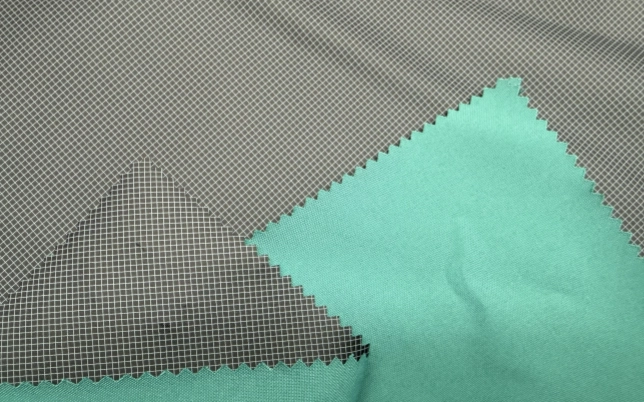
A 3-layer waterproof fabric, or 3L, integrates three functional components into one laminated structure:
Face Fabric + TPU Membrane + Backer
The outer woven fabric provides durability and surface protection; the TPU membrane controls waterproofing and moisture-vapor transfer; and the inner backer protects the membrane from friction, body contact and repeated wear.
Depending on the product brief, we can work with tricot, knitted backers or mesh constructions. The backer is not simply an extra layer added for appearance. Its weight, structure and hand feel can affect the final fabric’s durability, moisture management, flexibility and overall wearing experience.
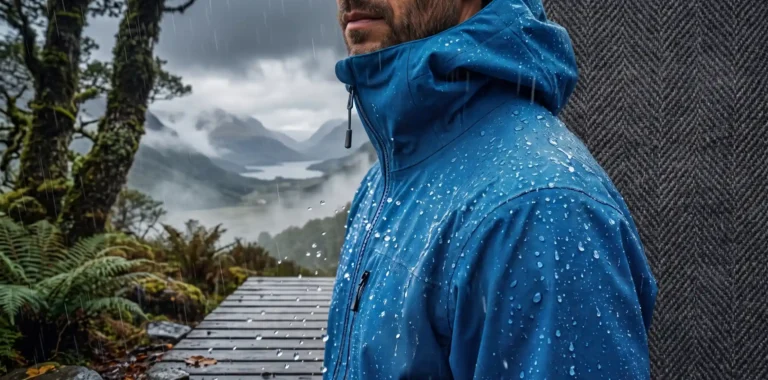
This makes 3-layer waterproof breathable fabric particularly relevant for technical hiking shells, ski jackets and other products where the laminated fabric itself is expected to provide a complete shell structure without relying on a loose internal lining.
2L vs 3L Waterproof Fabric: What Actually Changes?
The choice should not be reduced to “2L is basic and 3L is premium.” That is too simplistic for technical sourcing.
A well-developed 2L construction can be exactly right for one jacket, while moving to 3L could add unnecessary weight, cost or structure. In another application, the additional backer and integrated construction of a 3L fabric may be essential for durability and long-term comfort.
| Sourcing Factor | 2-Layer Fabric | 3-Layer Fabric |
|---|---|---|
| Construction | Face fabric + membrane | Face fabric + membrane + backer |
| Membrane Protection | Usually depends more on garment lining/construction | Backer directly protects membrane |
| Garment Design | Flexible; separate lining can be used | Integrated technical shell construction |
| Weight | Can support lightweight designs | Depends heavily on face and backer selection |
| Hand Feel | Influenced by face fabric and membrane | Influenced by face, membrane and backer |
| Durability | Application dependent | Well suited to demanding technical shells |
| Typical Direction | Running, cycling, packable outerwear | Hiking shells, ski jackets, technical outerwear |
| Development Complexity | Face + membrane + finishing must be balanced | Face + membrane + backer + lamination must work as one system |
The important sourcing question is therefore not which construction has more layers, but which construction delivers the required performance with the least unnecessary compromise.
Waterproof Ratings: Is 20,000 mm Always Better?
Hydrostatic pressure indicates resistance to water penetration and is one of the first specifications buyers look at when sourcing Waterproof Breathable Fabric.
Depending on the customer’s product requirement, our developments may target hydrostatic-head levels such as 5,000 mm, 10,000 mm or 20,000 mm. A lightweight running jacket and a technical hiking shell, however, do not necessarily need the same waterproof target.
Increasing waterproof performance can involve changes to the membrane or laminated structure, and those changes can influence softness, weight and moisture-vapor transmission. This is why we prefer to establish the actual end-use requirement before selecting a target.
A 20,000 mm waterproof fabric makes sense when the garment needs that level of protection. Specifying 20,000 mm simply because the number looks better on a hangtag can add complexity without necessarily improving the user’s experience.
MVTR: Waterproofing Is Only Half of the Development
Once a jacket blocks external water, moisture generated inside the garment becomes the next issue.
For active products such as hiking, running and cycling jackets, MVTR — Moisture Vapor Transmission Rate — is an important part of the development brief. Depending on customer requirements, projects may target 5,000, 10,000, 15,000 or 20,000 g/m²/24h.
A sourcing team should be careful when comparing these numbers between suppliers because MVTR results depend on the test method and test conditions. A value should therefore be read together with the specified laboratory method rather than treated as a universal number.
For Waterproof Breathable Fabric, hydrostatic pressure and MVTR should be developed together. Optimizing only one side of the equation can produce a technically impressive material that is uncomfortable in the finished garment.
TPU Membrane Selection Goes Beyond Waterproof and MVTR Numbers
TPU is the membrane direction we use for these laminated developments, but choosing a TPU membrane involves more than selecting waterproof and breathability specifications from a data sheet.
The membrane’s softness, transparency, stretch behavior and compatibility with the face fabric and lamination process can all affect the finished textile. These differences become particularly noticeable in lightweight shell constructions, where there is less fabric mass to mask membrane characteristics.
We saw this directly in a 3-layer waterproof breathable fabric for a European hiking-shell customer.
The customer’s original requirement was:
3L Hiking Shell / 20,000 mm Waterproof / 15,000 g/m²/24h MVTR
The customer initially requested a low-transparency TPU membrane. From a visual and functional specification perspective, the direction appeared reasonable, but during development another problem became obvious: the laminated fabric was too noisy.
The waterproof and breathability targets alone could not solve that issue.
A Real 3L Hiking Shell Development: When Fabric Noise Became the Problem
Fabric noise is easy to underestimate when reviewing technical specifications. It does not appear next to hydrostatic head or MVTR on the usual sourcing checklist, but once the material becomes a jacket, excessive rustling can noticeably affect the wearing experience.
In this European project, the low-transparency TPU requested by the customer produced more noise than was acceptable for the intended hiking shell. Rather than trying to compensate for the problem only through the face fabric or lamination conditions, we recommended changing the membrane direction.
We proposed a softer white TPU membrane that better matched the desired hand feel and acoustic performance while still allowing the laminated construction to meet the functional brief.
After redevelopment, the finished 3L fabric achieved the customer’s requirements for 20,000 mm waterproof performance and 15,000 g/m²/24h MVTR, and the final material passed the required third-party testing.
The useful lesson from this development is not that white TPU is universally better than low-transparency TPU. It is that a membrane can meet the numbers and still be wrong for the garment.
Color or transparency, softness, noise, stretch and lamination behavior all need to be evaluated alongside waterproof and breathable performance.
Face Fabric Selection for 2L and 3L Laminated Fabrics
The membrane is only one component of a laminated system. Face-fabric construction determines much of the material’s surface durability, appearance, weight, stretch and hand feel.
For lightweight programs, 20D or 40D nylon and 30D or 50D polyester can provide useful starting points when packability is important. Moving toward 70D nylon, 75D polyester or heavier constructions such as 150D polyester can provide additional structure and durability for more demanding applications.
Nylon/Spandex can also be considered when the garment requires greater mobility, but the stretch behavior of the face fabric has to remain compatible with the membrane and laminated structure.
This is particularly important in a TPU membrane waterproof fabric. It is not enough for each component to perform well individually; they need to move, recover and age as one laminated material.
C0 DWR and Non-PFAS Water Repellency
The face fabric of a waterproof shell still benefits from surface water repellency even when a TPU membrane provides the actual waterproof barrier.
Without effective surface repellency, the outer textile can become saturated during wet conditions. The membrane may continue blocking water penetration, but a saturated face can negatively affect weight, drying behavior and overall comfort.
For this reason, C0 DWR can be applied according to customer requirements. In buyer communication, terms such as non-PFAS DWR, fluorine-free water repellency and C0 DWR may all appear, so the exact chemical and regulatory requirements should be confirmed during development rather than assumed from terminology alone.
The DWR specification should also include durability expectations. Initial spray performance is useful, but for many technical programs the buyer will also want to know what happens after repeated laundering.
How We Test Waterproof Breathable Fabric Before Bulk Approval
For laminated fabrics, waiting until final bulk production to discover a waterproof, breathability or bonding problem creates unnecessary risk.
Our projects can be verified through customer-specified third-party laboratories including SGS, Intertek (ITS), Bureau Veritas (BV) or another laboratory nominated by the buyer. The exact methods and pass/fail criteria are determined by the customer’s specification.
Typical evaluation areas include:
| Performance | What It Tells the Buyer |
|---|---|
| Hydrostatic Head | Resistance to water penetration |
| MVTR | Moisture-vapor transmission performance |
| Water Repellency | Performance of the C0 / non-PFAS surface finish |
| Lamination / Bond Strength | Stability between laminated layers |
| Tear Strength | Resistance to tearing during use |
| Abrasion Resistance | Surface durability during repeated wear |
| Stretch & Recovery | Important for stretch face constructions |
| Dimensional Stability | Behavior after laundering |
| Color Fastness | Dye durability under specified conditions |
The important point is that the test standard should be agreed before production. A buyer asking for “20K waterproof” or “15K breathability” without defining the corresponding test method leaves room for different interpretations of the same number.
Which Construction Should You Choose for Your Jacket?
For a waterproof breathable fabric for hiking jackets, the decision should begin with the garment rather than the number of layers.
A lightweight running or cycling jacket may benefit from a 2L construction when low weight and garment-design flexibility are priorities. A technical hiking shell or ski jacket may justify 3L when the membrane needs permanent protection and the fabric itself is expected to function as an integrated shell.
Packable jackets can go either way depending on weight, durability and end-use requirements.
The table below is a practical starting point rather than a fixed specification:
| Garment | Possible Direction | Key Sourcing Question |
|---|---|---|
| Hiking Shell | 3L | How much durability, waterproofing and MVTR are required? |
| Ski Jacket | 3L | What waterproof, abrasion and backer performance is needed? |
| Running Jacket | 2L | Can weight be reduced while maintaining required weather protection? |
| Cycling Jacket | 2L | How should breathability, weight and wind protection be balanced? |
| Lightweight Packable Jacket | 2L or application-specific 3L | What is the acceptable trade-off between weight and durability? |
These are development directions, not universal rules. The customer’s garment construction and testing standard should always determine the final specification.
Custom 2L and 3L Waterproof Breathable Fabric Development
For brands looking for a custom laminated fabric supplier, the most useful starting point is not simply “We need waterproof fabric.”
A better brief tells us the jacket application, face-fabric preference, target denier and GSM, required hydrostatic pressure, MVTR target, stretch requirement, hand feel, DWR requirement and testing standard. For 3L programs, the desired backer—such as tricot, knit or mesh—also needs to be considered.
At CC Textile, we can develop 2L and 3L laminated constructions around these requirements, using different nylon, polyester and stretch-woven face fabrics together with TPU membrane solutions.
You can browse our functional fabric products or learn more about our custom fabric development services.
If you already have a reference fabric, test report or target specification, contact the CC Textile development team. Providing the target Hydrostatic Head, MVTR, GSM, hand feel and garment application gives us a much more useful starting point for development.
Waterproof Breathable Fabric FAQ
What is the difference between 2-layer and 3-layer waterproof fabric?
A 2L construction combines a face fabric with a waterproof breathable membrane. A 3L construction adds a textile backer behind the membrane, creating an integrated face + membrane + backer system. The appropriate choice depends on garment construction, weight, durability and intended use.
Is 3-layer waterproof fabric always better than 2-layer?
No. Three layers do not automatically mean a better garment. A 2L construction can be appropriate for lightweight running, cycling or other jacket designs, while 3L is often useful for technical shells requiring an integrated protective backer. The product brief should determine the construction.
Is 20,000 mm waterproof enough for a hiking shell?
A 20,000 mm hydrostatic-head target is used in technical waterproof applications, but the number should be considered together with the test method, garment construction and actual end use. Higher is not automatically better if other characteristics such as weight, softness and breathability are compromised.
What does 15,000 MVTR mean?
An MVTR value of 15,000 g/m²/24h describes a measured moisture-vapor transmission result under a specified test method. Because different methods and conditions can produce different results, sourcing teams should compare MVTR values only when the associated test protocols are understood.
Can C0 DWR make a fabric waterproof?
No. C0 DWR primarily reduces surface wetting. In a laminated Waterproof Breathable Fabric, the TPU membrane is responsible for the primary resistance to water penetration, while the DWR helps the outer face resist saturation.
What backer can be used for 3-layer waterproof fabric?
Depending on the customer’s garment and hand-feel requirements, options can include tricot, knitted backers and mesh structures. Backer selection influences durability, weight, touch and the overall character of the finished laminate.
Why can laminated waterproof fabric become noisy?
Fabric noise can come from the interaction between face fabric, membrane characteristics and lamination construction. A membrane that meets waterproof and MVTR specifications may still produce an unacceptable hand or acoustic response. This is why we recommend evaluating the finished laminate physically rather than approving membrane specifications only from a technical data sheet.
Final Thoughts
Choosing Waterproof Breathable Fabric is not simply a decision between 2L and 3L, nor should it be reduced to comparing the largest waterproof and MVTR numbers on two technical data sheets.
The face fabric, TPU membrane, backer, C0 DWR, lamination conditions, weight, hand feel and intended garment all work as one system. The European hiking-shell development described above is a good example: the original TPU direction could address the technical specification, but its noise made it unsuitable for the actual product. Changing to a softer membrane allowed us to balance measurable performance with the way the jacket needed to feel and sound in use.
That is ultimately what good functional-fabric development should do: meet the test specification without losing sight of the garment.
Explore CC Textile functional fabrics, learn about our fabric development capabilities, read our latest technical textile articles, or learn more about CC Textile.
For a new 2L or 3L jacket program, contact CC Textile with your face-fabric construction, GSM, Hydrostatic Head, MVTR, hand-feel and testing requirements.
Follow CC Textile on LinkedIn, Instagram, Facebook and TikTok.
WaterproofBreathableFabric #OutdoorFabric #TechnicalTextiles #FabricSourcing #OutdoorApparel