Outdoor Jacket Fabric can look excellent as a development swatch and still create problems after dyeing, finishing, lamination or bulk production. In our experience, these failures rarely come from one specification alone. They usually happen when weight, construction, waterproofing, breathability, hand feel and finishing are developed separately instead of as one system.
At CC Textile, we work with fabrics for lightweight windbreakers, hiking jackets, softshells, waterproof shells, ski jackets and workwear. These garments may all be described as “outdoor jackets,” but the fabric requirements can be very different. A 110 GSM summer shell should not be engineered in the same way as a ski jacket simply because both require water protection.
For sourcing and materials teams, the objective is therefore not to maximize every number on the technical data sheet. Good Outdoor Jacket Fabric needs the right balance of protection, breathability, durability, weight and hand feel for the actual garment.
Below are seven problems we pay particular attention to during development.
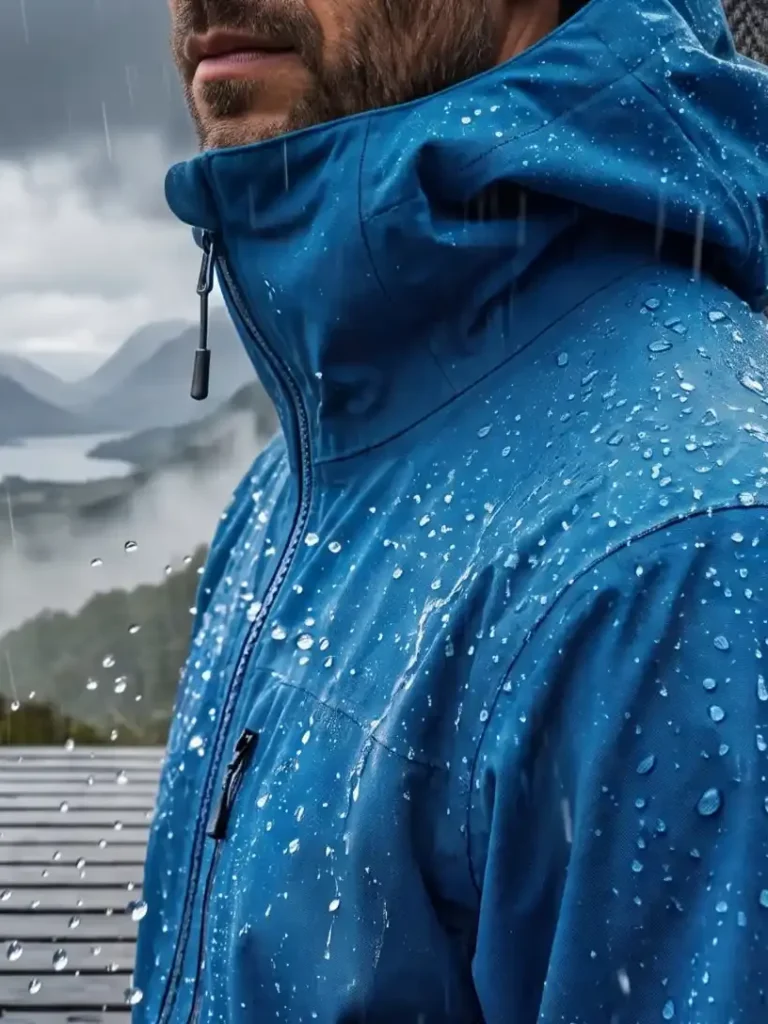
1. Choosing Outdoor Jacket Fabric by Weight Alone
Lightweight fabrics are increasingly important for packable windbreakers and spring/summer outdoor jackets, but GSM should never be evaluated by itself. Reducing weight normally changes the relationship between yarn denier, weave density, tear strength, abrasion resistance and air permeability.
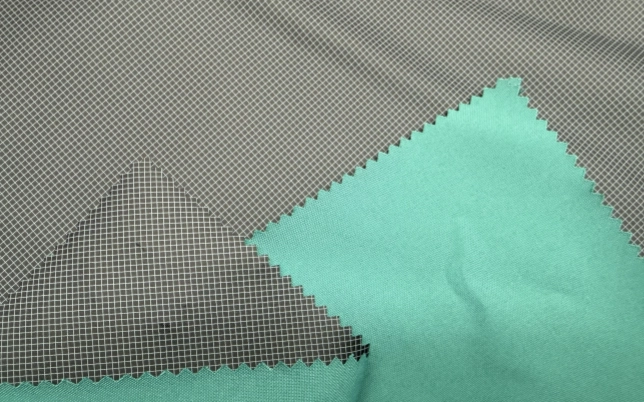
We commonly develop Outdoor Jacket Fabric using 40D and 70D nylon, 75D and 150D polyester, Nylon/Spandex and Polyester/Spandex stretch wovens, as well as ripstop and Taslan constructions. Which direction works best depends on the jacket.
| Jacket Application | Typical Fabric Direction | Main Development Priority |
|---|---|---|
| Lightweight Windbreaker | 40D–70D Nylon / 75D Polyester | Low weight, packability, wind resistance, C0 DWR |
| Hiking Jacket | Nylon/Spandex or Polyester/Spandex woven | Mobility, durability, breathability |
| Softshell Jacket | Stretch woven + functional finish | Stretch, hand feel, wind resistance |
| Rain / Waterproof Shell | Nylon or Polyester + membrane | Hydrostatic pressure, breathability |
| Ski Jacket | Durable face fabric + membrane | Waterproofing, abrasion resistance |
| Workwear Jacket | 150D Polyester, Taslan or durable woven | Tear and abrasion resistance |
A lightweight outdoor jacket fabric for warm-weather hiking may prioritize airflow and packability, while a fabric for rough terrain needs additional tear and abrasion performance. The correct starting point is the garment’s use, not simply the lowest available GSM.
2. Confusing C0 DWR with Waterproof Fabric
This distinction sounds basic, but it causes real problems during fabric development.
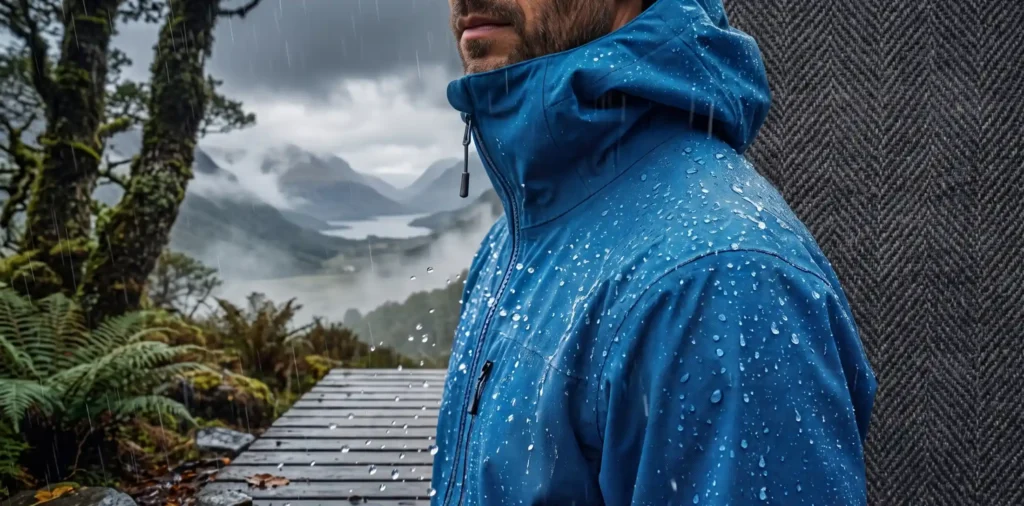
C0 DWR is a surface water-repellent finish. It helps water bead on the face of the fabric and reduces surface wetting, but C0 DWR alone does not create the waterproof barrier associated with PU coating, TPU membrane or laminated constructions.
For Outdoor Jacket Fabric, C0 DWR should therefore be treated as one part of the weather-protection system rather than a substitute for waterproofing.
A lightweight windbreaker that encounters occasional rain may only need durable surface repellency. A waterproof shell designed for prolonged exposure needs a different construction, typically involving a coating or membrane together with suitable garment construction.
This is why a sourcing brief that simply says “waterproof” is often not enough. We need to know the actual end use, required water-repellency level, hydrostatic-pressure target, breathability requirement and wash durability before deciding how the fabric should be finished.
3. Ignoring Temperature During C0 DWR Processing
This is where fabric development moves beyond a specification sheet and into actual production control.
We recently worked on a lightweight Outdoor Jacket Fabric for a European customer. The starting specification was approximately 70D Nylon / 110 GSM, with requirements for weather protection and breathability.
During production, however, achieving the customer’s required strong C0 water-repellent performance became difficult because the summer processing environment was very hot.
Instead of simply increasing the finishing chemistry, we worked on the processing conditions. For this particular production run, a substantial quantity of ice was added during the water-repellent treatment to reduce and stabilize the treatment-bath temperature.
After adjustment, the finished fabric achieved an initial water-repellency rating of Grade 4 and retained approximately Grade 3–3.5 after 20 wash cycles under the project’s specified test conditions.
This does not mean adding ice is a universal solution for every C0 DWR fabric. Chemistry, construction, equipment, temperature and curing conditions all interact differently. What this case demonstrates is that C0 DWR performance depends on process control as well as the finishing agent itself.
For our projects, wash-durability targets may be set at 20 washes or developed according to the customer’s specific requirement.
4. Maximizing Waterproofing While Ignoring Breathability
A high hydrostatic-pressure result looks impressive on a specification sheet, but it does not automatically make a better jacket.
For active outdoor apparel, the fabric also has to manage moisture generated inside the garment. If a waterproof construction restricts moisture-vapor transfer too heavily, the wearer can become uncomfortable even though rain never penetrates the fabric.
In Outdoor Jacket Fabric development, waterproofing and breathability therefore need to be evaluated together. Depending on the customer’s requirements, we may consider MVTR (Moisture Vapor Transmission Rate) alongside hydrostatic pressure and other relevant performance measurements.
PU coatings and TPU membranes can both be used to create weather protection, but the final result depends on much more than the membrane name. Face-fabric density, coating or membrane characteristics, lamination conditions and finishing all affect the behavior of the completed material.
For a waterproof breathable jacket fabric, the useful question is not “How high can the waterproof number go?” but whether the chosen waterproof/breathability balance makes sense for the garment’s activity level and climate.
5. Approving Hand Feel Before Coating or Lamination
One of the easiest mistakes to make is approving a base fabric because it feels soft, then assuming that hand feel will remain unchanged after functional processing.
It often does not.
In our own development work, we have encountered cases where PU coating made the fabric noticeably firmer, while TPU membrane lamination changed the drape and overall hand feel. Both problems were eventually resolved by adjusting the finishing route and processing conditions around the customer’s final requirement.
The important point is that the final hand feel of Outdoor Jacket Fabric should be evaluated after the relevant DWR, coating or lamination process whenever possible.
This becomes especially important with lightweight shells and softshell fabrics. The garment may meet its hydrostatic-pressure target but still be commercially unsuccessful if the finished fabric is too stiff, noisy or uncomfortable.
Performance and hand feel therefore cannot be developed in separate rooms. They have to be approved as part of the same finished material.
6. Waiting Until Finished Bulk Fabric to Start Testing
Finding a performance problem after bulk finishing is expensive. Finding it earlier gives the production team more options.
For our Outdoor Jacket Fabric orders, testing is integrated into production rather than being treated only as a final inspection. We normally control the order through key stages including greige fabric, dyeing and finishing, followed by testing through the customer’s designated third-party laboratory when required.
The exact testing program depends on the buyer and garment, but typical jacket-fabric evaluations include:
| Performance | Why It Matters | Typical Test Direction |
|---|---|---|
| Water Repellency | Evaluates C0 DWR surface performance | AATCC 22 / ISO 4920 |
| Hydrostatic Pressure | Measures resistance to water penetration | ISO 811 / JIS L 1092 |
| Breathability / MVTR | Evaluates moisture-vapor transfer | Buyer-specified method |
| Air Permeability | Helps evaluate wind protection and airflow | Buyer-specified method |
| Tear Strength | Evaluates resistance to tearing | ASTM D2261 / ISO 13937 |
| Abrasion Resistance | Evaluates surface durability | ISO 12947 / ASTM D4157 |
| Dimensional Stability | Checks dimensional change after laundering | AATCC 135 / ISO 6330 |
| Color Fastness | Checks color durability for intended use | Relevant AATCC / ISO 105 methods |
Where independent verification is required, we work with customer-appointed laboratories and organizations such as SGS, Intertek (ITS) and Bureau Veritas (BV).
Testing Outdoor Jacket Fabric at different production stages also helps us identify where a problem entered the process. A construction problem discovered at greige stage requires a very different solution from a performance change that appears only after coating or lamination.
7. Forcing a Standard Fabric into a Custom Jacket Program
Ready-developed fabrics are useful when the existing construction already matches the garment. Problems arise when the product team tries to adapt a technically unsuitable fabric simply because it is immediately available.
One customer may want to reduce GSM without losing tear strength. Another may need better C0 DWR wash durability. A third may have the correct waterproof performance but dislike the hand feel after TPU lamination. Stretch, surface texture, anti-static performance or a specific coating requirement may add further variables.
This is why working with a custom outdoor jacket fabric supplier should involve more than selecting an item number from a catalog.
At CC Textile, we prefer to begin with the actual development brief: garment application, fiber composition, yarn denier, target GSM, weave construction, stretch, hand feel, water-repellency or waterproof requirement, breathability, wash durability and required testing standards.
From there, we can determine whether an existing construction is appropriate or whether the yarn, weaving, dyeing, coating, membrane or finishing route needs to be adjusted.
Buyers can browse our functional fabric products or learn more about our custom fabric development services.
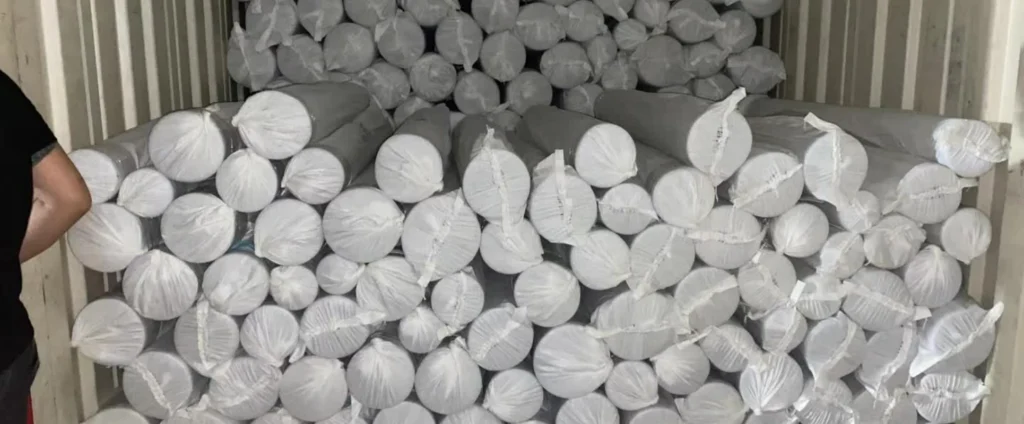
What the 70D Nylon Development Taught Us
The European 70D Nylon project is a useful example because the solution was not to abandon the lightweight construction or simply apply more finishing chemistry.
The 70D / approximately 110 GSM Outdoor Jacket Fabric already suited the customer’s lightweight jacket concept. The problem emerged during C0 DWR processing under high summer temperatures. By adjusting process temperature and then verifying the finished performance after washing, we were able to maintain the lightweight construction while reaching the project’s required water-repellency level.
That type of issue rarely appears on a swatch card or standard technical data sheet.
It also illustrates something sourcing teams sometimes overlook: when buying functional fabrics, manufacturing process control can be just as important as the original specification.
Developing Outdoor Jacket Fabric Around the Garment
A productive development usually begins with a clear product brief rather than a request for “the best jacket fabric.”
For a lightweight windbreaker, that brief might prioritize low GSM, controlled air permeability and C0 DWR. A hiking jacket may shift the balance toward stretch, abrasion resistance and moisture management, while a waterproof shell introduces hydrostatic pressure, membrane selection, MVTR and lamination requirements.
This garment-first approach allows Outdoor Jacket Fabric to be engineered around the actual use case rather than maximizing technical numbers that may add cost or compromise comfort without improving the finished product.
If you are developing a new jacket, send us the target garment type, composition, denier, GSM, stretch requirement, hand feel, weather-protection target and required testing standards. Our fabric development team can use those parameters as the starting point for construction and finishing trials.
Outdoor Jacket Fabric FAQ
What is the best Outdoor Jacket Fabric?
There is no single best construction. Lightweight windbreakers can use 40D–70D nylon or lightweight polyester, hiking jackets may benefit from stretch woven fabrics, and waterproof shells normally require a coating or membrane system. Ski and workwear jackets usually place greater emphasis on durability. The garment’s end use should determine the specification.
Is C0 DWR the same as waterproofing?
No. C0 DWR primarily provides surface water repellency. A waterproof fabric normally requires an appropriate coating, membrane or laminated construction together with suitable garment construction.
What is the difference between C0 DWR and TPU membrane?
C0 DWR reduces surface wetting, while a TPU membrane provides a functional barrier within a laminated fabric system. They perform different jobs and can be used together when the product specification requires both surface repellency and resistance to water penetration.
How can waterproof Outdoor Jacket Fabric remain breathable?
Waterproofing and breathability need to be engineered together. Face-fabric construction, membrane or coating characteristics and lamination all affect moisture-vapor transfer. The correct combination depends on the intended activity and the buyer’s specified performance targets.
How long does C0 DWR last after washing?
There is no responsible universal number. Performance depends on fabric construction, finishing chemistry, processing conditions, laundering method and the test standard. In the European 70D Nylon development discussed above, the fabric achieved Grade 4 initially and retained approximately Grade 3–3.5 after 20 wash cycles under that project’s specified conditions.
What information should I send to an Outdoor Jacket Fabric supplier?
A useful brief includes the jacket type, composition, denier, target GSM, construction, stretch requirement, desired hand feel, DWR or waterproof target, breathability requirement, wash durability and testing standards. A reference fabric or existing test report can also help accelerate development.
Final Thoughts
Successful Outdoor Jacket Fabric development is rarely about maximizing one specification. A fabric can be highly waterproof but uncomfortable, extremely light but insufficiently durable, or beautifully soft before processing and noticeably different after coating or lamination.
The better approach is to develop the material as a complete system—fiber, yarn, construction, GSM, DWR, coating or membrane, breathability, hand feel and testing—and verify those decisions throughout production.
At CC Textile, we support lightweight windbreakers, hiking jackets, softshells, waterproof shells, ski jackets and workwear programs, from existing fabric sourcing through custom Outdoor Jacket Fabric development.
Explore our performance fabric collection, learn about our fabric development capabilities, read more technical textile articles, or contact CC Textile with your next jacket specification.
Learn more about CC Textile and follow us on LinkedIn, Instagram, Facebook and TikTok.
OutdoorJacketFabric #PerformanceFabric #FabricSourcing #TechnicalTextiles #OutdoorApparel