Lightweight Hiking Pants Fabric: Essential Sourcing Guide
Reducing fabric weight is relatively easy. Reducing it without losing abrasion resistance, stretch recovery and comfort is where the real development work begins.
When sourcing Lightweight Hiking Pants Fabric, GSM should never be treated as an isolated target. A summer trekking pant may need better airflow and faster drying, while a more technical hiking style needs enough surface durability to handle repeated contact with rocks, backpacks and vegetation. Once stretch, water repellency and hand feel are added to the brief, the fabric has to be engineered as a complete system rather than selected simply because it feels light in the hand.
In our development work at CC Textile, we normally begin with the garment’s end use and work backward into fiber, yarn denier, weave construction, weight, stretch and finishing. For many lightweight hiking programs, the goal is not the lowest possible GSM; it is the lowest practical weight that can still meet the durability and comfort requirements of the finished garment.
What Should Lightweight Hiking Pants Fabric Actually Deliver?
For warm-weather hiking and trekking pants, weight needs to be balanced against abrasion resistance, mobility, moisture management and the level of weather protection required for the intended environment. These properties influence one another, which is why maximizing a single specification rarely produces the best garment.
A tighter woven construction, for example, can improve wind resistance and surface durability but may reduce air permeability. Increasing elastane can improve mobility, yet the resulting fabric still needs adequate recovery to prevent bagging at the knees and seat. Adding a functional finish can improve water repellency, but excessive coating or finishing may change the hand feel and breathability that made the lightweight construction attractive in the first place.
For a sourcing team, this means the development brief should define the intended activity, climate, garment weight and required test performance before the mill starts adjusting construction.
Nylon vs. Polyester for Lightweight Hiking Pants
Both nylon and polyester can be engineered into Lightweight Hiking Pants Fabric, but their strengths are not identical. Nylon is frequently selected for technical outdoor trousers where abrasion resistance, tear performance and a softer technical hand are priorities, while polyester is often considered when quick drying, dimensional stability and commercial cost targets play a larger role.
The fiber name alone, however, is not enough to predict performance. Yarn denier, filament type, weave density, fabric construction and finishing can produce very different results even within the same fiber family.
| Buyer Concern | Nylon / Nylon-Spandex | Polyester / Polyester-Spandex |
|---|---|---|
| Abrasion & Tear Performance | Strong option for technical outdoor applications | Good when construction is properly engineered |
| Hand Feel | Often soft and smooth with a technical touch | Can range from crisp to soft depending on yarn and finish |
| Quick Drying | Good | Typically very good |
| Stretch Options | Mechanical stretch or elastane-based stretch | Mechanical stretch or elastane-based stretch |
| Cost Positioning | Generally higher | Often more cost-efficient |
| Typical Applications | Technical hiking and trekking pants | Hiking, travel and high-volume outdoor programs |
For brands searching for the best fabric for hiking pants, the practical answer is therefore not simply “nylon” or “polyester.” The right choice depends on what the garment has to do and which performance characteristics matter most after repeated wear and laundering.
Choosing GSM, Denier and Weave Construction
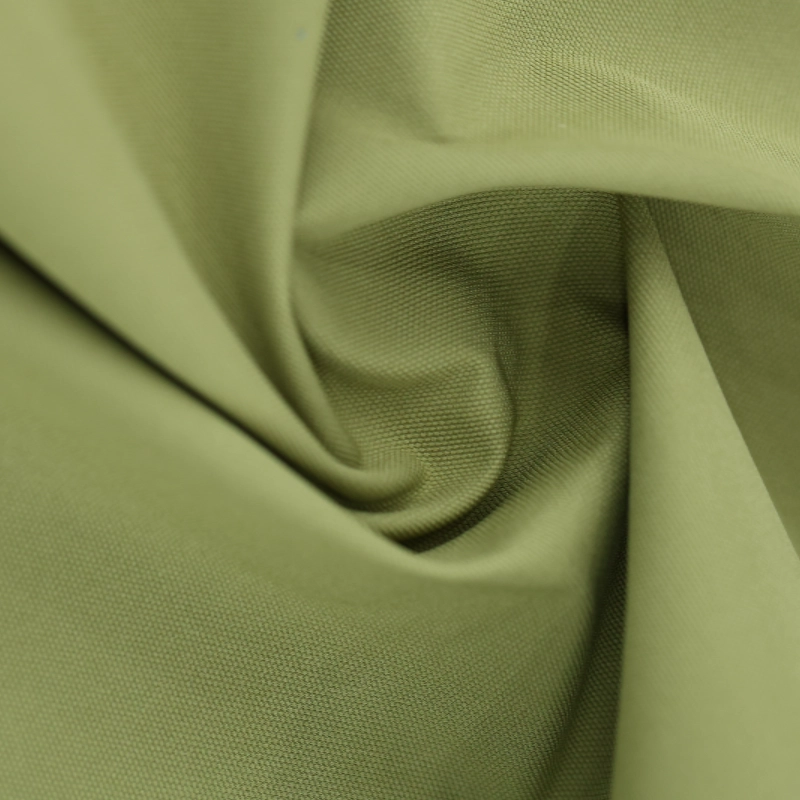
When developing Lightweight Hiking Pants Fabric, 40D–70D yarns and approximately 100–150 GSM can provide a useful starting range. These figures should be treated as development references rather than universal specifications because an ultralight summer pant and a rugged trekking pant place very different demands on the material.
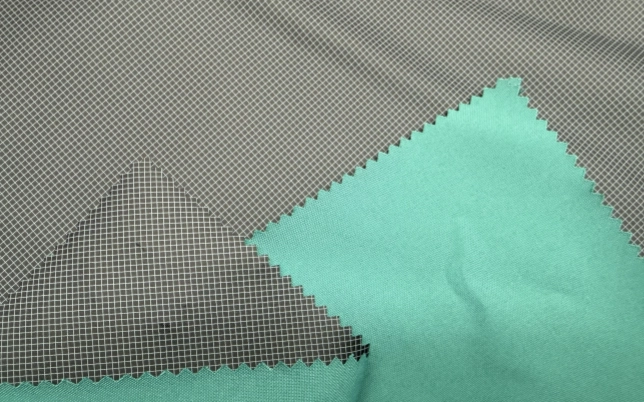
A lower-denier construction can improve packability and reduce garment weight, while moving toward 70D or a denser construction can provide additional durability for more demanding outdoor use. Weave selection adds another variable: plain weave can produce a clean and lightweight surface, twill can add body and a different drape, while ripstop structures are useful when tear propagation is a particular concern.
An abrasion resistant stretch woven fabric is therefore not created by nylon content alone. The relationship between yarn specification, weave density, fabric weight and finishing has to be considered together.
Mechanical Stretch or Elastane?
Stretch construction should also follow the garment brief. Mechanical stretch can be useful when a brand wants mobility with little or no elastane, while Nylon/Spandex constructions are commonly selected when greater extension and freedom of movement are required.
For a true four-way stretch woven, both warp and weft behavior need to be considered along with elastic recovery. Our CC-2480 Nylon Four-Way Stretch Fabric is one example of the type of stretch woven construction that can be considered when developing performance trousers and other active outdoor garments.
The sourcing decision should not be based only on how far a swatch stretches by hand. What matters in the finished garment is whether the material returns close to its original dimensions after repeated movement.
Why Stretch Recovery Matters More Than Maximum Stretch
A fabric with impressive initial elongation can still perform poorly if recovery is inadequate. During hiking, repeated flexing at the knees, hips and seat puts continuous stress on the fabric; insufficient recovery may eventually show up as bagging, distortion or loss of garment fit.
This is why we evaluate elastane content, warp/weft construction, heat setting and dimensional stability as part of the same development process. For woven stretch fabrics, ASTM D3107 and ISO 20932 are among the methods that may be specified to evaluate stretch and recovery characteristics.
The target should be agreed according to the customer’s garment and testing protocol rather than applying one recovery number to every hiking-pants program.
Does Lightweight Hiking Pants Fabric Need C0 DWR?
A water repellent hiking pants fabric can be useful for light rain, damp vegetation and incidental splashes, but the level of weather protection should match the actual use of the garment.
For many hiking-pants programs, a C0 DWR finish provides surface water repellency without turning the fabric into a waterproof barrier. Water-repellency performance can be evaluated using methods such as AATCC 22 or ISO 4920, including after laundering when durability is part of the buyer’s specification.
This distinction matters because DWR and waterproofing solve different problems. A DWR finish helps reduce surface wetting; it does not make the fabric waterproof. PU coatings, TPU membranes and laminated constructions can provide much higher resistance to water penetration, but they also change weight, air permeability, moisture transport and hand feel.
For a lightweight hiking pant, adding a membrane simply to achieve a larger waterproof number may work against the comfort requirements of the original product brief. The finishing package should provide enough protection for the intended environment rather than the maximum protection technically available.
Quick-Dry Performance and Warm-Weather Comfort
A quick dry hiking pants fabric needs more than a marketing finish. Fiber selection, construction, fabric density and moisture-management finishing all influence how quickly moisture spreads and dries.
For summer hiking, buyers should consider air permeability and drying behavior alongside GSM. A fabric can be very light but still feel uncomfortable if its construction restricts airflow or if the inner surface remains wet and clings to the skin.
This is another reason we prefer to evaluate the complete fabric construction rather than treating “quick dry,” “lightweight” and “breathable” as independent labels.
Testing Lightweight Hiking Pants Fabric Before Bulk Approval
A swatch that feels good in a showroom does not tell a sourcing team how the fabric will behave after repeated movement, laundering or trail abrasion. Before bulk approval, the testing plan should reflect the actual risks of the finished garment.
| Performance | Why It Matters | Typical Test Method |
|---|---|---|
| Abrasion Resistance | Evaluates durability under repeated surface friction | ISO 12947 / ASTM D4157 |
| Tear Strength | Evaluates resistance once a tear has started | ASTM D2261 / ISO 13937 |
| Stretch & Recovery | Measures elongation, growth and recovery | ASTM D3107 / ISO 20932 |
| Water Repellency | Evaluates surface DWR performance | AATCC 22 / ISO 4920 |
| Dimensional Stability | Checks size and shape after laundering | AATCC 135 / ISO 6330 |
| Color Fastness | Evaluates color durability under the specified end-use conditions | Relevant AATCC / ISO 105 methods |
The exact test protocol should be agreed with the buyer because different brands and markets may specify different methods, conditioning procedures and pass/fail requirements. Where required, CC Textile works with third-party testing organizations such as SGS, Intertek (ITS) and Bureau Veritas (BV) according to customer specifications.
A Practical Development Example: Lightweight Stretch Fabric for Hiking Pants
A typical Lightweight Hiking Pants Fabric development brief might begin with a summer hiking pant for the European or U.S. market that needs four-way mobility, a lightweight hand, surface water repellency and enough durability for regular outdoor use.
Rather than immediately choosing the lowest GSM available, one possible development starting point would be a 70D Nylon/Spandex woven construction around 120–140 GSM, using a lightweight plain or twill structure. The finishing route could then combine C0 DWR with a controlled soft-hand treatment, while the stretch construction is adjusted according to the customer’s target mobility and recovery.
The next stage is validation. Abrasion and tear performance indicate whether reducing weight has compromised durability; stretch and recovery testing helps predict whether knees and seat areas will retain their shape; dimensional stability checks the effect of laundering; and water-repellency testing confirms whether the finishing package meets the agreed requirement.
If one result is outside the target, we adjust the construction rather than simply adding more finishing chemistry. That may mean changing yarn denier, density, elastane ratio, heat-setting conditions or fabric weight before repeating the relevant tests.
This is the practical difference between selecting an existing fabric and developing one around a specific garment.
Working With a Custom Hiking Pants Fabric Supplier
For brands looking for a custom hiking pants fabric supplier, a detailed product brief is usually more valuable than asking for “our best hiking fabric.”
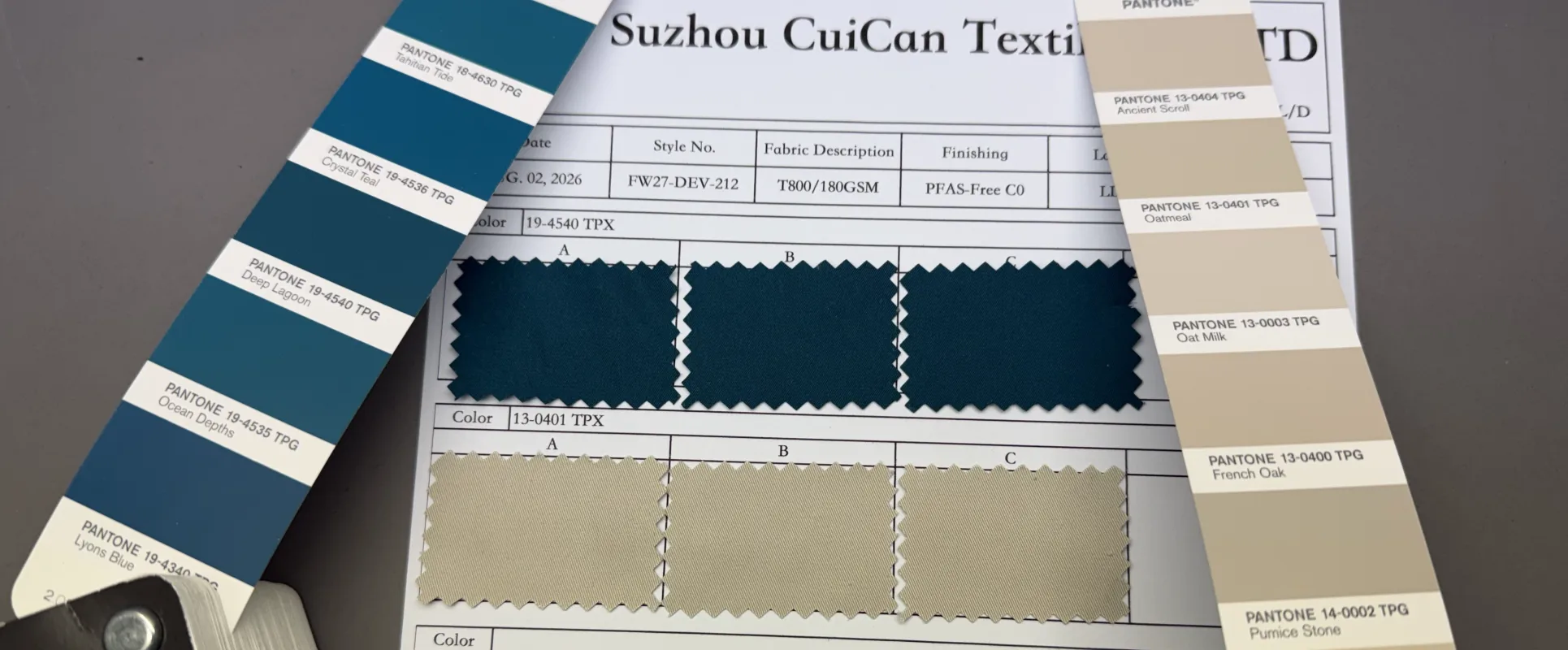
The most useful starting information includes the intended garment, target composition and GSM, preferred hand feel, stretch requirement, expected weather protection and required testing standards. With those parameters defined, the fabric mill can evaluate whether an existing construction is suitable or whether yarn, weave or finishing needs to be modified.
At CC Textile, our custom performance fabric development services cover yarn selection, woven construction, weight adjustment, dyeing, stretch engineering and functional finishing. Buyers can also browse our functional fabric range to establish a starting point for new development.
If you are working on a new hiking or trekking pant, you can contact the CC Textile fabric development team with your target GSM, composition, stretch, hand feel and test requirements. These specifications give us a much more useful starting point for fabric trials than a generic request for a lightweight outdoor fabric.
Sourcing FAQ
What is the best fabric for hiking pants?
There is no single construction that is best for every hiking pant. Nylon and Nylon/Spandex stretch wovens are strong candidates when abrasion resistance, tear performance and mobility are priorities, while polyester constructions can be attractive for quick-dry performance, dimensional stability and commercial programs. The correct specification depends on the intended activity, climate and garment design.
Is nylon or polyester better for lightweight hiking pants?
Nylon is commonly considered for technical hiking and trekking trousers where durability and abrasion performance are important. Polyester can be well suited to quick-dry hiking, travel and value-oriented outdoor programs. In both cases, yarn type, denier, weave density and finishing can be just as important as fiber selection.
What GSM is suitable for lightweight hiking pants?
Approximately 100–150 GSM can be a useful development range for many lightweight woven hiking-pants fabrics, but it should not be treated as a fixed standard. An ultralight summer pant may move below this range, while a more rugged trekking style may require additional weight or a more durable construction.
Do hiking pants need C0 DWR?
Not necessarily, but C0 DWR can be useful when the garment needs resistance to light rain, wet vegetation and surface moisture. DWR provides surface water repellency; it should not be confused with a waterproof coating or membrane.
Is 4-way stretch necessary for hiking pants?
No. Mechanical stretch and two-way stretch can work well for many designs. Four-way stretch becomes useful when the garment requires greater multi-directional mobility, but stretch recovery, durability and garment patterning should be evaluated alongside maximum elongation.
Final Thoughts
Choosing Lightweight Hiking Pants Fabric is ultimately an exercise in balance. Reducing GSM makes sense only when the resulting construction can still provide the abrasion resistance, tear strength, mobility, recovery and comfort expected from the finished garment.
For sourcing and materials teams, the most reliable approach is to define the end-use requirement first and then work backward through fiber selection, yarn denier, GSM, weave construction, stretch system and functional finishing. This makes it possible to engineer a fabric around the product rather than forcing the product around an available fabric.
Learn more about CC Textile, explore our fabric development capabilities, or read our latest technical textile articles.
You can also follow CC Textile on LinkedIn, Instagram, Facebook and TikTok.
HikingPantsFabric #OutdoorFabric #FabricSourcing #PerformanceTextiles #OutdoorApparel