
Production Risk Starts Long Before Manufacturing Begins
Production risk is one of the biggest concerns for apparel brands sourcing fabrics and garments internationally. According to industry reports, quality issues and production delays remain among the most common challenges in global apparel manufacturing. In many cases, the real problem is not what happens on the production line—it is what happens before production even begins.
A missing specification, an unapproved color, an unrealistic delivery schedule, or poor communication can all create costly consequences later. Once bulk production starts, even a small mistake may require reworking fabric, reproducing garments, or delaying shipments.
After more than 20 years in textile and garment manufacturing, we have learned one important lesson: most production problems are preventable. The earlier risks are identified, the easier and less expensive they are to solve.
In this article, we’ll explain the most common production risks we see before mass production and share practical ways to reduce them.
Key Takeaway
Most production problems do not happen overnight. They are usually the result of small details that were overlooked before production began.
Why Production Risk Starts Before Manufacturing
Many buyers believe production begins when a factory starts making fabric or sewing garments.
In reality, manufacturing starts much earlier.
Every decision made during product development influences the final result.
For example:
- Is the Tech Pack complete?
- Has the Lab Dip been approved?
- Has the PPS been signed?
- Are quality standards clearly defined?
- Is the production schedule realistic?
- Does the supplier understand both fabric and garment production?
If any of these questions remain unanswered, production risk increases immediately.
This is why experienced manufacturers spend more time preparing before production than fixing problems afterward.
Production Risk Comparison: High Risk vs. Best Practice
| Production Stage | High Risk | Best Practice |
|---|---|---|
| Tech Pack | Sketches with limited specifications | Complete technical package with fabric, trims, testing requirements, and measurements |
| Color Approval | Skip or rush Lab Dip approval | Approve Lab Dip before bulk dyeing |
| Fabric Inspection | Inspect only after finishing | Inspect greige fabric before dyeing |
| PPS | Start bulk production without PPS approval | Approve and sign the PPS before production |
| Quality Control | Final inspection only | Inline inspection plus final inspection |
| Production Follow-up | Wait for factory updates | Track production throughout every stage |
A structured workflow like this helps reduce production risk while improving quality consistency and delivery performance.
Incomplete Tech Packs Increase Production Risk
One of the most common reasons production problems occur is an incomplete technical package.
Sometimes a buyer only provides a design sketch and a short product description.
However, a professional manufacturer needs much more information before production begins.
A complete Tech Pack should include:
- Fabric composition
- Fabric construction
- Weight (GSM)
- Color reference
- Performance requirements
- Garment measurements
- Sewing details
- Trims and accessories
- Packaging requirements
- Testing standards
Without these details, different factories may interpret the same product in different ways.
The development sample may look acceptable, but the final bulk production may not meet expectations.
Preparing a detailed Tech Pack takes time, but it greatly reduces production risk later.
Rushing Sample Approval Creates Production Risk
Many apparel brands work under tight seasonal deadlines.
As a result, samples are sometimes approved too quickly.
Unfortunately, saving a few days during sample approval can create weeks of production problems.
Before approving any sample, buyers should evaluate more than appearance.
Important checks include:
- Fabric performance
- Color fastness
- Shrinkage
- Waterproof performance
- Breathability
- Garment measurements
- Sewing quality
For functional fabrics, appearance alone is never enough.
A sample should confirm that the same quality can be achieved consistently during bulk production.
Spending a little more time on sample evaluation often saves significant time and cost later.
Unrealistic Production Lead Times Increase Production Risk
Another common mistake is underestimating the time required before mass production begins.
A complete production schedule includes much more than factory manufacturing time.
For example, our typical workflow includes:
Fabric Development
- Lab Dip: 5–7 days
- PP Sample: 7–10 days
- Bulk Fabric Production: 15–20 days after contract confirmation and deposit receipt
Garment Manufacturing
- Sample Development: 1–2 weeks
- Bulk Production: 35–50 days, depending on style and production complexity
However, buyers should also allow time for:
- Internal approvals
- Fabric testing
- Sample reviews
- Design adjustments
- Shipping arrangements
A realistic schedule allows every stage to be completed properly without unnecessary pressure.
Pressure rarely improves quality. Good planning does.
Late Color Changes Can Delay the Entire Production Schedule
Changing a color may sound like a simple decision. In reality, it can affect almost every stage of textile production.
Once bulk fabric production has been scheduled, several processes are already connected, including yarn preparation, dyeing plans, machine allocation, finishing, and delivery arrangements.
When a color is changed at this stage, factories often need to adjust production schedules, prepare new dye formulations, and reorganize machine capacity. Even a small change can affect the delivery date.
One question we hear quite often is:
“Why does the Lab Dip match perfectly, but the bulk fabric looks slightly different?”
The answer lies in how these two stages are produced.
A Lab Dip is a small color sample developed under laboratory conditions. Technicians can adjust the dye formula several times until the required color is achieved.
Bulk production is different.
During bulk dyeing, hundreds or even thousands of meters of fabric are processed in industrial dyeing machines. Although modern equipment controls temperature, chemical dosage, and processing time automatically, slight variations are still normal in textile production.
Professional factories control these variations within agreed industry tolerances, but expecting every production batch to be identical to a laboratory sample is unrealistic.
For projects with strict color requirements, we always send bulk fabric approval samples before garment production begins. This extra confirmation helps both sides agree on the final production standard and avoids unnecessary misunderstandings later.
Early Fabric Inspection Is One of the Best Ways to Reduce Production Risk
Many factories focus on inspecting finished garments.
We believe quality control should begin much earlier.
Once fabric has been dyed, coated, laminated, cut, and sewn into garments, correcting a defect becomes expensive. Fabric, trims, labor, and production time may all be lost.
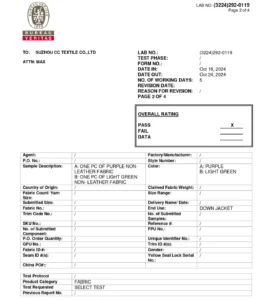
That is why we inspect greige fabric before dyeing whenever possible.
At this stage, our technicians can identify problems such as:
- Weaving defects
- Broken yarns
- Density variations
- Surface imperfections
Finding these issues early allows us to solve them before additional processing costs are added.
If a weaving defect is discovered only after garments have been sewn, the consequences can be serious. The fabric may need to be replaced, garments recut and resewn, trims reordered, and delivery schedules adjusted.
A problem that begins with one roll of fabric can quickly affect the entire production order.
This is why we believe prevention is always less expensive than correction.
Case Study: Finding a Problem Before It Became a Bigger One
During one outdoor apparel project, our team identified weaving defects while inspecting the greige fabric before dyeing.
Because the issue was discovered at such an early stage, the affected fabric was replaced before any dyeing, cutting, or sewing had started.
The customer did not need to remake finished garments or delay shipment. More importantly, the production schedule remained on track.
Experiences like this reinforce an important lesson:
The earlier a problem is found, the easier it is to solve.
PPS Approval Is More Important Than Many Buyers Realize
Some buyers see the Pre-Production Sample (PPS) as just another sample.
In reality, it becomes the reference standard for the entire production order.
Once the PPS has been reviewed and approved, both the buyer and the factory should use it as the benchmark for bulk production.
The approved PPS confirms details such as:
- Fabric
- Color
- Measurements
- Sewing construction
- Labels
- Trims
- Finishing
Without a clearly approved PPS, different departments may work from different versions of the product, increasing the risk of inconsistency.
From our experience, careful PPS approval also protects both the buyer and the manufacturer.
Occasionally, market conditions change after an order has been placed. A brand may experience slower sales or decide to postpone a product launch. When there is no clearly approved production standard, disagreements about quality are more likely to arise.
A signed PPS provides a clear reference for both parties and helps avoid unnecessary disputes.
Choose a Technical Partner, Not Just a Supplier
Price is important.
However, choosing a manufacturing partner should involve much more than comparing quotations.
An experienced supplier should understand the complete production process—from fabric development to finished garments—and identify potential risks before production begins.
A technical partner should be able to answer questions such as:
- Is this fabric suitable for the intended application?
- Will this construction meet the required performance standards?
- Can the requested lead time be achieved realistically?
- Are there any risks that should be addressed before production starts?
At CC Textile, every order is followed by experienced team members who understand fabrics, garment production, and quality control. Instead of waiting for problems to appear, we work to identify and solve them as early as possible.
After more than two decades in this industry, we have found that successful production depends less on reacting quickly and more on planning carefully.
A reliable supplier does not simply manufacture products.
They help reduce production risk before manufacturing even begins.
LinkedIn / Facebook
LinkedIn
https://www.linkedin.com/in/cc-textile/
Facebook
https://www.facebook.com/cctextileltd
OEKO-TEX® – https://www.oeko-tex.com/en/
SGS Textiles & Apparel – https://www.sgs.com/en/our-services/textiles-and-apparel
Intertek Textiles – https://www.intertek.com/textiles/
AATCC – https://www.aatcc.org/
ISO Textile Standards – https://www.iso.org/ics/59.080/x/
Explore our Functional Fabrics collection or contact our OEM Garment Manufacturing team to better manage your production workflow.
#TextileManufacturing #GarmentManufacturing #FabricSourcing #QualityControl #ApparelIndustry