A buyer brief often arrives in one line: lightweight camouflage fabric, UPF 50+, insect repellent and water repellent.
It sounds straightforward. In production, it is not.
The base fabric, stretch recovery, printing process and functional finishes all affect one another. A camouflage pattern may look perfect on the first strike-off but lose shade consistency after finishing. A water-repellent treatment may make a lightweight fabric feel too firm. A fabric may achieve UPF 50+ when relaxed but perform differently when stretched across the knees, seat or elbows.
For hunting suits, fishing clothing, hiking trousers and lightweight summer jackets, the correct approach is to develop the fabric as one complete system rather than adding functions individually.
At CC Textile, we work backwards from the finished garment: intended climate, garment structure, fibre composition, weave, GSM, stretch, printing route, finishing compatibility and final testing. This reduces one of the most common sourcing risks—approving individual features that do not perform consistently once combined.
Why Multifunctional Outdoor Fabric Briefs Often Go Wrong
Outdoor clothing buyers usually need several properties from the same fabric:
- freedom of movement
- stable stretch recovery
- custom camouflage or branded artwork
- protection against ultraviolet exposure
- reduced insect contact
- surface water repellency
- comfortable hand feel in warm weather
- reliable performance after laundering
The difficulty is that improving one property can weaken another.
A tighter construction can support UV protection and wind resistance, but it may reduce air permeability. A higher elastane content can improve mobility, but poor heat-setting may cause bagging around the knees and seat. Additional finishing chemistry may improve surface performance while making the fabric too firm or noisy for hunting garments.
Printing adds another layer of risk. Nylon and polyester require different dye systems, fixation conditions and process temperatures. The wrong printing route can affect colour depth, dimensional stability, hand feel and stretch recovery.
This is why a technical outdoor fabric supplier should not ask only, “Which finishes do you need?” The more useful question is:
Can the finished, printed and laundered fabric meet the agreed performance specification as one complete construction?
Start With the Garment, Not the Finish List
The same functional package should not be applied to every outdoor garment.
A warm-weather hunting suit, a pair of fishing trousers and a lightweight hiking jacket face different movement, weather and comfort requirements. The working environment should determine the fabric construction before the finish package is selected.
Hunting and Camouflage Suits
Hunting garments may be worn for long periods in vegetation, damp ground and insect-prone environments. The fabric needs to balance camouflage definition, mobility, low noise, UPF performance, insect repellency and surface water repellency.
A finish that is too heavy can alter the drape and sound of the fabric. This is particularly important when the wearer must move quietly through vegetation.
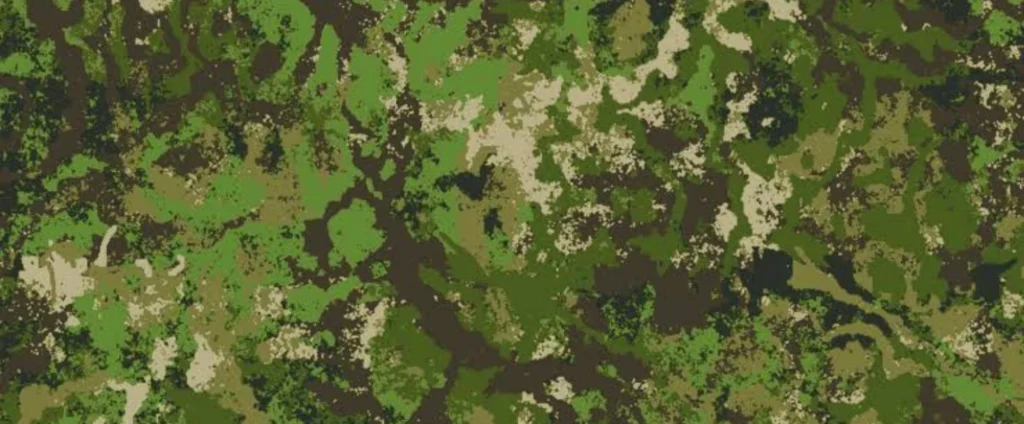
Camouflage scale also matters. A pattern that looks convincing on an A4 strike-off may appear too repetitive across a complete jacket and trouser set. Artwork repeat, colour separation and garment panel placement should therefore be approved before bulk production.
Fishing, Hiking and General Outdoor Clothing
Fishing and hiking fabrics are exposed to strong sunlight, sweat, repeated movement, light rain and frequent laundering.
UPF performance, stretch recovery, air permeability and drying behaviour are often more important than simply selecting the lowest possible GSM. A very lightweight fabric may feel comfortable when new but lack sufficient opacity, durability or recovery for long-term use.
For summer hiking pants, a practical fabric should feel light without becoming transparent, unstable or excessively open when stretched.
Lightweight Summer Jackets and Trousers
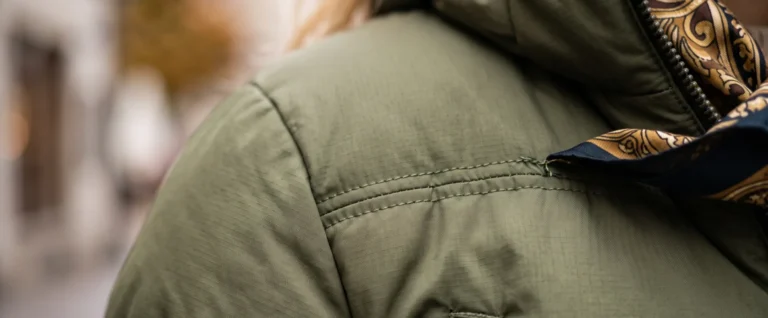
For hot-weather garments, the priorities normally include low practical weight, packability, breathable comfort, shape recovery and light surface protection.
Dense constructions and excessive finishing can work against summer comfort. The fabric must therefore be evaluated after printing and finishing, not only as an unfinished base cloth.
Choose the Fibre Before Choosing the Printing Process
Nylon-spandex and polyester-spandex can both be used for multifunctional outdoor apparel, but they should not be treated as interchangeable.
Fibre choice determines the most suitable digital printing route, fixation process and finishing conditions.
Acid-Dye Direct-to-Fabric Printing for Nylon
For nylon, the professional process is acid-dye direct-to-fabric digital printing, also known as acid inkjet printing.
The nylon fabric is pretreated and printed directly with acid dyes. It is then steamed to fix the colour and washed to remove unfixed dye. Final pH, wash-off efficiency and heat-setting must be controlled carefully, especially when elastane is present.
This printing route can produce detailed camouflage artwork while preserving the technical character of a lightweight nylon stretch woven. However, approval should cover more than the appearance of the first strike-off.
The finished fabric should be checked for:
- colour fastness
- shade consistency
- dimensional change
- stretch and recovery
- surface hand
- performance after functional finishing
- appearance after laundering
DWR and insect-repellent chemistry should also be trialled on the actual printed construction. A finish that works well on a solid-dyed fabric may behave differently on a digitally printed nylon fabric.
Sublimation Heat-Transfer Printing for Polyester
Polyester-spandex is normally printed by sublimation heat transfer.
Disperse dye moves from printed transfer paper into the polyester under controlled heat and pressure. This process is commercially efficient for repeatable camouflage patterns, outdoor graphics and custom artwork.
Heat is also the main technical risk.
Transfer temperature and total heat history can influence finished width, hand feel, dimensional stability and elastane recovery. A polyester-spandex fabric should therefore not be approved on colour alone.
For both nylon and polyester, the buyer should confirm:
- artwork repeat size
- camouflage scale
- colour reference
- print position
- garment panel layout
- approved strike-off
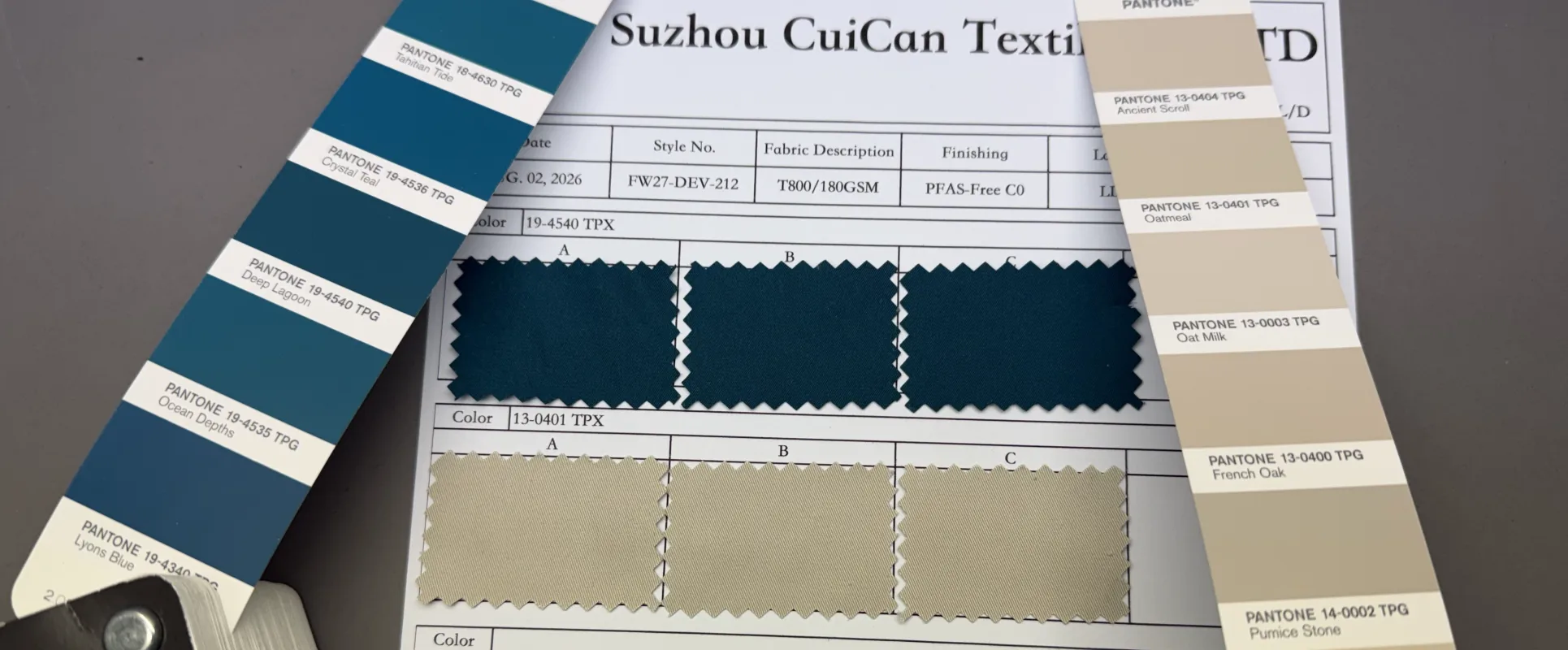
- post-finishing shade
- bulk colour tolerance
A hunting brand may need a large, non-obvious camouflage repeat. A fishing or hiking collection may prioritise clearer colour separation and consistent placement across jacket and trouser panels.
Build the Functional Package Around the Printed Fabric
Repel Mosquito® Performance With Wash Durability
For insect-prone environments, CC Textile can apply Repel Mosquito® technology from Smart Inovation.
The technology is designed as an insect repellent rather than an insecticide. It is intended to discourage contact from mosquitoes, ticks, flies and other insects.
This distinction is important. Mosquito-repellent fabric should not be promoted as a medical guarantee against insect-borne disease.
For selected CC Textile developments, technical documentation can be provided showing retained repellent performance after 80–100 wash cycles.
However, “80–100 washes” should never appear in a purchase specification without supporting conditions. The buyer and supplier should confirm:
- washing programme
- detergent
- drying procedure
- exact number of cycles
- test organism
- initial performance
- post-wash performance
- required acceptance threshold
ISO 24461:2022 provides a method for evaluating anti-mosquito performance, while ISO 6330:2021 defines domestic washing and drying procedures used in textile testing.
The final order should follow the specific method and laundering protocol stated in the applicable technical documentation.
UPF 50+ Must Be Tested on the Finished Fabric
UPF 50+ is a measured result, not a claim created by writing “anti-UV” on a specification sheet.
Fabric density, colour, stretch, moisture, print coverage and laundering can all influence ultraviolet transmission. A pale colour may perform differently from a dark camouflage shade, even when both use the same construction.
For the US market, AATCC TM183 is commonly used to measure ultraviolet transmission or blocking through fabric.
The specimen should be the finished, printed and treated fabric in the approved colour.
If the garment will be worn under significant stretch, the buyer should also consider whether stretched-condition testing is required. This is particularly relevant to fitted nylon-spandex trousers, articulated hunting garments and close-fitting fishing clothing.
A UPF 50+ test report can be provided for applicable developments without publishing the laboratory or report details on the website.
PFAS-Free C0 DWR Is Not Waterproofing
“Waterproof fabric” was one of the relevant search terms found in the advertising report, but it must be used carefully.
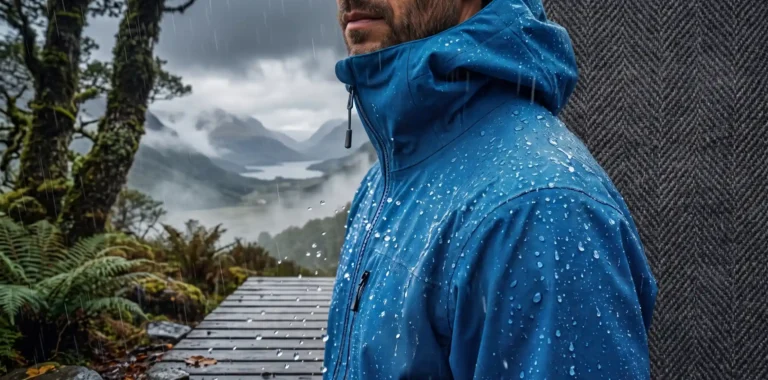
PFAS-free C0 DWR provides surface water repellency. It helps water bead and roll off the fabric during light rain, splashes or contact with wet vegetation.
It does not create the hydrostatic resistance of a PU coating, TPU membrane or laminated waterproof construction.
Buyers comparing coated fabric suppliers, outdoor fabric suppliers or technical textile companies should separate three different requirements:
Surface Water Repellency
A C0 DWR finish reduces surface wetting and helps the outer fabric dry more easily. It is suitable for light rain and wet outdoor conditions but is not a waterproof barrier.
Surface performance can be evaluated using methods such as AATCC TM22-2024 or ISO 4920:2012.
ISO 4920 evaluates resistance to surface wetting. It is not intended to predict rain penetration through the fabric.
Coated Fabric
A coating such as PU is applied to the fabric surface or reverse side to create increased resistance to water penetration. The coating can change breathability, weight, hand feel and drape.
Laminated Fabric
A waterproof and breathable construction normally uses a membrane, such as TPU, laminated between or behind textile layers. This route requires testing for hydrostatic pressure, breathability and bonding durability.
If a garment requires true waterproof protection, the buyer should specify the required water-penetration test and target result. The term “waterproof” should not be used for a standard C0 DWR fabric unless the complete construction has passed the required test.
For PFAS-free programmes, CC Textile can arrange third-party PFAS testing against an agreed analyte list, sample stage, reporting limit and buyer requirement. More information is available in our PFAS textile compliance guide.
Test the Final Combination, Not Four Separate Claims
A base fabric may pass a spray test before printing and lose surface water repellency after the full production route. A UPF result may change when a stretch fabric is tested under a different condition. Mosquito-repellent durability means little unless post-laundering performance is measured.
The most reliable approval plan tests the final construction, colour, print and functional finish package intended for bulk production.
Depending on the end use, the purchase specification should define:
- finished composition, GSM and usable width
- approved construction and stretch direction
- artwork, colour reference and repeat size
- stretch and recovery requirements
- colour fastness to washing and rubbing
- dimensional stability
- UPF test method and required result
- insect-repellent test method and wash protocol
- initial and after-wash DWR rating
- applicable PFAS testing scope
- final sample approval standard
This is not a standard wholesale apparel fabric purchase. Each performance claim needs to be connected to a measurable condition.
A Practical Development Process for Apparel Brands
A useful enquiry begins with the garment rather than a finish name.
Send a tech pack, reference garment, fabric swatch or product image together with the intended climate and wearing conditions. Composition, GSM, width, stretch, hand feel, printing method and target price can then be reviewed as one brief.
The next step is selecting the printing route.
Nylon artwork moves through acid-dye digital printing trials. Polyester artwork moves through sublimation strike-offs. The approved artwork, repeat size and colour reference then become part of the final fabric specification.
Functional finishes should be applied to the selected printed base fabric. UPF, C0 DWR, insect repellency and PFAS requirements can then be confirmed against the agreed testing scope.
If a result falls outside the target, the development route may need adjustment in construction, pretreatment, printing, chemistry, curing or process order before the final sample is approved.
CC Textile’s custom fabric development services support sample matching, specification review, custom printing, functional finishing, third-party testing and bulk production follow-up.
You can also review our outdoor and apparel fabric collection or read our lightweight hiking pants fabric guide before starting a new programme.
Brief Examples From Our Current Development Range
The following products are short examples of how the development route changes according to fibre and end use.
CC-5226 Polyester-Spandex Outdoor Fabric
CC-5226 is a 90% polyester and 10% spandex plain-weave stretch fabric.
- Weight: 210 GSM
- Width: 150 cm
- Printing: sublimation heat-transfer camouflage printing
- Functions: UPF 50+, PFAS-free C0 DWR and Repel Mosquito® treatment
It is suitable for hunting suits, printed outdoor sets and structured fishing or hiking garments where colour repeatability and functional performance are required.
CC-5366 Nylon Four-Way Stretch Fabric
CC-5366 is a 92% nylon and 8% spandex four-way stretch plain weave.
- Weight: 165 GSM
- Width: 150 cm
- Printing: acid-dye direct-to-fabric digital printing
- Functions: UPF 50+ and PFAS-free C0 DWR
It provides a lighter route for technical trousers, hunting garments and summer outdoor jackets requiring mobility and a more technical nylon hand.
CC-1568 Printed Mesh Lining
CC-1568 is a 100% polyester printed mesh lining.
- Weight: 100 GSM
- Width: 155 cm
- Printing: digital pattern customisation
It can be used as the lining for the CC-5366 nylon four-way stretch outer fabric, creating a coordinated printed outdoor suit construction.
All final specifications and performance targets remain subject to sample approval and the agreed test protocol.
Sourcing FAQ
What is a multifunctional outdoor fabric?
A multifunctional outdoor fabric combines several coordinated properties in one finished construction. These may include custom camouflage printing, mosquito repellency, UPF 50+, stretch recovery and PFAS-free C0 DWR.
The construction should be developed for a specific garment rather than selected only from a list of finishes.
Can one fabric combine camouflage printing, UPF 50+, mosquito repellency and C0 DWR?
Yes, but the combination requires compatibility trials.
Fibre, dye chemistry, fixation, finishing and curing conditions can affect one another. Approval should be based on the final printed and treated sample, not on separate unfinished swatches.
Is PFAS-free C0 DWR fabric waterproof?
No.
C0 DWR provides surface water repellency for light rain, splashes and wet vegetation. A genuinely waterproof fabric normally requires a coating, membrane or laminated construction and should be assessed using an appropriate water-penetration test.
How long does the mosquito-repellent effect last after washing?
For selected Repel Mosquito® developments, CC Textile can provide technical documentation showing retained performance after 80–100 wash cycles.
The final claim must remain tied to the specified washing programme, test method, fabric construction and post-wash acceptance result.
Which digital printing method is used for nylon and polyester?
Nylon is developed using acid-dye direct-to-fabric digital printing.
Polyester is normally developed using sublimation heat-transfer printing with disperse dyes. The printing method should follow the fibre because the dye chemistry and fixation conditions are different.
What testing documents can buyers request?
Depending on the selected development, buyers can request:
- mosquito-repellent wash-durability technical documentation
- UPF 50+ test reports
- third-party PFAS test reports
- agreed colour-fastness and dimensional-stability results
- surface water-repellency test results
The required test methods and acceptance levels should be confirmed before bulk production.
What information is needed for a custom quotation?
Please provide:
- garment application
- preferred fibre composition
- target GSM and width
- stretch requirement
- artwork or camouflage reference
- required functional finishes
- testing requirements
- order quantity
- destination
- required delivery date
A physical fabric swatch or reference garment is especially useful when hand feel, stretch recovery and construction are difficult to describe in a tech pack.
Develop Your Outdoor Fabric as One System
The strongest multifunctional outdoor fabric is not the one with the longest finish list. It is the one whose construction, printing process and performance package have been developed for a specific garment and verified after the complete production route.
If you are developing a hunting suit, fishing outfit, hiking garment or lightweight summer jacket and trousers, you can:
Send us your intended application, composition, target GSM, artwork, performance requirements and order quantity. We will recommend a practical development route based on the finished garment rather than simply adding finishes to an existing fabric.
Follow CC Textile on LinkedIn for new fabric developments, production updates and technical sourcing notes.
#OutdoorFabric #CamouflageFabric #UPF50Fabric #MosquitoRepellentTextile #PFASFreeDWR