Many outdoor brands are making the same transition.
To comply with tightening environmental regulations, they are replacing traditional C6 water-repellent finishes with PFAS-free C0 DWR. The laboratory report looks good, the fabric supplier confirms it is PFAS-free, and the development sample performs exactly as expected.
Then bulk production begins.
A few weeks later, the finished garments are tested again.
Unexpectedly, the product fails the customer’s PFAS requirements.
For many sourcing managers, this is one of the most frustrating situations in apparel manufacturing.
The supplier insists the fabric is PFAS-free.
The test report proves it.
So why did the finished garment fail?
In many cases, the fabric was never the problem.
The problem happened somewhere else in the supply chain.
A PFAS-Free Fabric Doesn’t Always Mean a PFAS-Free Garment
This is one of the biggest misunderstandings in today’s textile industry.
When a fabric supplier says a fabric is PFAS-free, they are usually referring to the fabric itself after dyeing and finishing.
That statement may be completely accurate.
However, a garment is much more than fabric.
By the time a jacket reaches the customer, it has gone through multiple manufacturing processes involving different materials, chemicals, accessories, and production equipment.
Each additional process creates another opportunity for unintended PFAS contamination.
This is why more international brands are beginning to evaluate the entire finished garment, rather than relying only on the fabric test report.
A Real Case: When Everyone Was Right—But the Garment Still Failed
One outdoor apparel brand experienced exactly this problem.
Before bulk production, the fabric was tested several times by internationally recognized laboratories, including ITS, SGS, and Bureau Veritas (BV).
Every report showed compliant results.
The laboratory reports indicated:
- Per individual PFAS: < 25 ppb
- Total PFAS: < 250 ppb
From the fabric supplier’s perspective, there was nothing wrong.
The reports were genuine, and the fabric fully met the customer’s PFAS requirements.
Confident with the results, the customer approved the fabric and started garment production.
Then came the surprise.
When the finished garments were tested, the PFAS levels exceeded the customer’s specification.
Immediately, questions were raised.
The brand suspected that the fabric supplier had provided false test reports.
The fabric supplier insisted the reports were authentic.
For more than two months, both sides reviewed production records, repeated laboratory testing, and checked every manufacturing step to identify the source of the problem.
Eventually, the answer had nothing to do with the fabric itself.
The investigation found that cross-contamination had occurred during downstream processing.
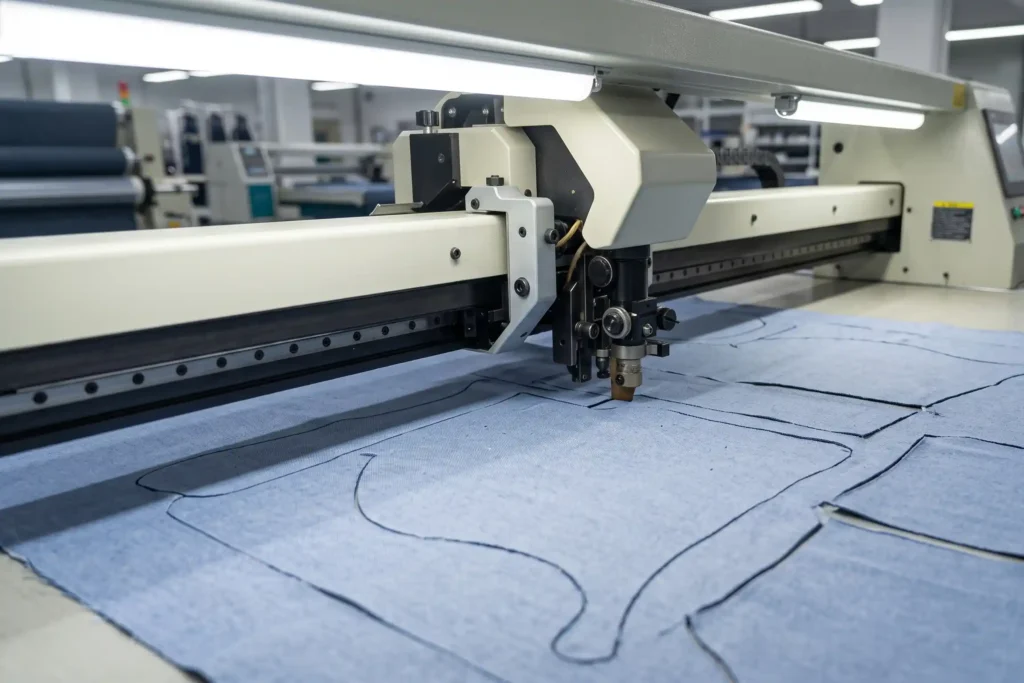
The contamination was introduced during fabric inspection, fabric rolling, and even on the cutting table, where equipment and work areas had previously been used for fluorinated materials.
In other words, the fabric was genuinely PFAS-free.
The finished garment was not.
No one had intentionally done anything wrong.
The problem was that the supply chain had not been managed as a complete PFAS-free system.
This case highlights an important lesson for every apparel brand.
Testing the fabric alone is no longer enough.
To achieve genuine PFAS compliance, every stage—from fabric finishing and warehouse handling to garment manufacturing and final inspection—must follow the same standard.
Where Can PFAS Cross-Contamination Happen?
Fabric Inspection
Inspection tables and handling equipment that have previously been used for fluorinated products may transfer trace amounts of PFAS to compliant fabrics.
Fabric Rolling and Packing
Rolling machines, packaging materials, or storage areas shared with conventional waterproof fabrics may become another source of contamination.
Cutting Tables
During garment production, fabrics are spread and cut on large production tables.
If those tables have previously processed fluorinated materials without proper cleaning procedures, cross-contamination may occur before sewing even begins.
Seam Tape and Waterproof Accessories
Seam tapes, waterproof zippers, elastic cords, hook-and-loop fasteners, and other trims are often sourced from different suppliers.
Even if the fabric is PFAS-free, these accessories may not be.
Heat Transfer Logos and Printing
Reflective logos, heat transfers, and printing chemicals should also be reviewed.
A single non-compliant component can affect the entire finished garment.
Garment Finishing
Additional washing or finishing treatments after sewing may introduce chemicals that were never present in the original fabric.
Why Passing the Spray Test Isn’t Enough
Many buyers still evaluate waterproof fabrics using only the AATCC 22 Spray Test.
This test measures how effectively water beads on the fabric surface.
It is useful for comparing new fabrics, but it does not indicate how the finish performs after repeated washing.
Consumers don’t judge a jacket when it’s brand new.
They judge it after months of outdoor use.
This is why wash durability is becoming just as important as the initial spray rating.
Why Some PFAS-Free DWR Finishes Lose Performance After Washing
Traditional C6 finishes relied on fluorinated chemistry with extremely low surface energy.
Modern PFAS-free C0 finishes use different technologies, often based on hydrocarbon or silicone chemistry.
While environmentally preferable, these finishes generally have weaker adhesion to polyester and nylon fibres.
Repeated washing, abrasion, and everyday wear can gradually reduce the effectiveness of the water-repellent finish.
As a result, the outer fabric begins to absorb water—a phenomenon known as wetting out.
Consumers often believe the jacket is leaking.
In reality, the waterproof membrane may still be functioning, but once the face fabric becomes saturated, breathability decreases and the garment feels colder and heavier.
Why Adding More Chemicals Isn’t the Solution
Some manufacturers attempt to improve durability simply by increasing the concentration of C0 finishing chemicals.
Unfortunately, this rarely solves the problem.
Excessive chemical application may create new issues, including:
- Chalk marks on dark fabrics
- Stiffer fabric hand feel
- Uneven surface appearance
- Higher production costs
Long-lasting performance depends on how well the finish bonds to the fibre—not how much chemistry is applied.
Cross-Linking Chemistry Improves Wash Durability
Modern PFAS-free finishing systems increasingly use cross-linking technology.
Cross-linking agents help create stronger chemical bonds between the water-repellent finish and the fibre surface.
Instead of sitting loosely on the fabric, the finish becomes more resistant to repeated washing and abrasion.
For outdoor brands, maintaining water repellency after multiple wash cycles is often more valuable than achieving an excellent result on a brand-new fabric.
How Should Buyers Evaluate PFAS-Free Waterproof Fabrics?
Looking at a single laboratory report is no longer enough.
A better evaluation should combine multiple test methods.
AATCC 22 Spray Test
Measures the initial water repellency of the fabric surface.
Useful for comparing fresh DWR performance.
Bundesmann Rain Shower Test
The Bundesmann Rain Shower Test evaluates how fabrics perform under continuous rainfall.
Unlike a simple spray test, it measures water absorption, surface wetting, and rain resistance under conditions that better represent real outdoor use.
Using both tests provides a much clearer understanding of long-term waterproof performance.
Building a Truly PFAS-Free Supply Chain
Transitioning from C6 to C0 is no longer simply about replacing one finishing chemistry.
It requires every stage of the supply chain to work toward the same objective.
That includes:
- Fabric development
- Dyeing and finishing
- Accessories
- Garment manufacturing
- Printing
- Seam sealing
- Final inspection
A PFAS-free fabric does not guarantee a PFAS-free garment.
A PFAS-free supply chain does.
How CC Textile Helps Reduce PFAS Compliance Risks
At CC Textile, we believe successful PFAS compliance begins long before bulk production.
Rather than focusing only on fabric sourcing, we help customers manage the complete process—from functional fabric development to garment manufacturing, quality inspection, and shipment coordination.
By looking at the entire supply chain instead of only the fabric, we help customers reduce the risk of unexpected compliance issues later in production.
Learn more about our company on our About Us page:
Follow us for the latest textile insights and product updates:
LinkedIn:
https://www.linkedin.com/in/cc-textile/
Facebook:
https://www.facebook.com/cctextileltd
Conclusion
As PFAS regulations continue to evolve, buyers need to think beyond fabric certificates.
A fabric may genuinely be PFAS-free, yet the finished garment can still fail compliance if cross-contamination occurs during manufacturing or if additional materials do not meet the same standard.
The brands that succeed will not simply choose PFAS-free fabrics.
They will build PFAS-free supply chains.
That is the difference between passing a laboratory test and delivering a product that continues to meet customer expectations in the real world.